BAE Systems Produces and Certifies £D Printed Part for Use of BAe 146 Jetliner

SAMSUNG CSCBAE Systems Regional Aircraft has designed and achieved European Aviation Safety Agency (EASA) Form 1 certification approval for an aircraft part for the BAe 146 regional jetliner using innovative new 3D printing (Additive Manufacture) technology.

“The part is a plastic window breather pipe used as a vent to stop cabin windows misting up. These pipes were originally made by injection moulding in plastic, but the tooling that had been used by the supplier was no longer available. New tooling would have cost £14,000 ($23,200) and involved several months lead-time. In addition, the lead-time to actually produce the parts would have been a further two months.

Philip Beard, structures support manager at BAE Systems Regional Aircraft contacted the central engineering team at the BAE Systems Military Air & Information business at Warton, Lancashire who are busily experimenting with and building knowledge on 3D printing technology.

“Within two weeks our Warton colleagues had produced examples of the part and once we had used these to gain certification, they introduced us to a commercial 3D printing supplier who was able to produce the required quantity for us,” said Beard. “Not only was there the significant time saving and the avoidance of the tooling cost, but the actual parts cost 60 percent less than the traditional method.”

Three hundred of the window vent pipes were made and these are now in stock at Regional Aircraft’s Weybridge spares warehouse and are being shipped to customers for use as they require on in-service aircraft.


[s2If is_user_logged_in()]
READ FULL STORY >>>
[/s2If]
[s2If is_user_not_logged_in()]
[message_box title=”To READ the full article in our digital edition you need to be a registered subscriber to the magazine – If you are NOT then goto the SUBSCRIBE section of the site first before you can login” color=”green”]

[login-shortcode]

[/message_box]
[/s2If]

OEM Support for Commercial Rotorcraft

By Todd Vorenkamp

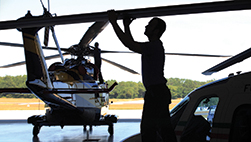
AgustaWestlandpic251When compared to the companies producing today’s business jets, manufacturers of commercial helicopters face support and maintenance challenges that are unique to the rotorcraft operational environment no matter the aircraft’s mission. The utilitarian nature of the helicopter has the aircraft operating in some of the most remote areas of the globe in unforgiving environments. Helicopters are not usually crossing great distances at high altitude while traveling from large airport to large airport—they are likely flying from remote bases to oil rigs, logging sites, power lines, construction zones, medical facility helipads, or city heliports.

Also unique to helicopter is the extent at which the machine is acted upon by constant vibration and, because it is operating at lower altitudes, environmental wear and tear. Working helicopters are not always landing on paved surfaces; they are often setting down in confined areas and unprepared landing zones full of dust, rocks, snow and any number of foreign debris. Coupled with the fact that, when compared to fixed-wing aircraft, helicopters have a relatively high number of flight-critical dynamic components, OEMs face a constant challenge to rapidly deploy parts and maintenance expertise to the field to keep customers flying.

Because of the variety of missions that helicopters perform, the flight dynamics of rotary-wing flight, and the fact they often operate from remote locations, the support network from the aircraft manufacturers must be flexible, responsive and far-reaching in order to compete with third-party repair centers and parts dealers while delivering value and service to the customer.

Warranty Programs
Sikorsky offers its customers two basic warranty options. Sikorsky’s Total Assurance Program and Powertrain Assurance Program each provide fixed-cost-per-flight-hour maintenance programs to operators of the S-76 helicopter and S-92 helicopter. The Total Assurance Program covers the cost of repairing or replacing the majority of parts, including airframe, drive train, gearboxes, and avionics. The Powertrain Assurance Program narrows the coverage to gearboxes. A third program provides loaner rotor blades and component exchanges. Sikorsky’s programs are currently supporting over 165 operators in 24 countries.

Bell Helicopter also offers customers of new aircraft an option of three different warranty plans offering customer-selected options such as local repair, supplier repair, Bell repair and warranty credit for the cost of replacement parts. They also offer warranty programs for customers purchasing a used Bell Helicopter.

Robinson Helicopter’s new aircraft warranty covers parts and provides a labor allowance for two years or 1000 flight-hours, whichever occurs first. They do not offer a fixed-cost per flight hour. Buyers of a used Robinson may subscribe to a factory overhaul program.

AgustaWestland offers three basic service plans for customers—a Component Protection Agreement, Special Component Protection Agreement, and a Component Overhaul and Maintenance Program that covers major components on a flight-hour basis. The Italian arm of AgustaWestland refers to the programs as “Extended Warranty Programs” versus “Power by the Hour” for the U. S. programs.


[s2If is_user_logged_in()]
READ FULL STORY >>>
[/s2If]
[s2If is_user_not_logged_in()]
[message_box title=”To READ the full article in our digital edition you need to be a registered subscriber to the magazine – If you are NOT then goto the SUBSCRIBE section of the site first before you can login” color=”green”]

[login-shortcode]

[/message_box]
[/s2If]

Bombardier Inaugurates its First Asia-Pacific Service Center

Bombardier recently inaugurated and opened its new full-scale, company-owned service center located at Seletar Airport in Singapore. Bombardier welcomed Mr. S. Iswaran, Minister, Prime Minister’s office and Second Minister for Home Affairs and for Trade and Industry and Mrs. Heather Grant, Canadian High Commissioner to Singapore, as well as more than a hundred other guests including customers, government officials and members of the aerospace community to its facility to celebrate this occasion.

The facility features 3,000 sq. meters (32,000 sq. feet) of hangar space, 3,500 sq. meters (38,000 sq. feet) of dedicated ramp, 3,500 sq. meters (38,000 sq. feet) of workshop, warehouse and office space. The service center includes a staff of more than 40 employees and is equipped to perform scheduled and unscheduled maintenance, as well as modifications, avionics installations and aircraft on ground (AOG) support for Bombardier Learjet, Challenger and Global aircraft.

“Growing services and support in the Asia-Pacific region is a top priority for Bombardier,” said Michel Ouellette, president, Customer Services & Specialized and Amphibious Aircraft, Bombardier Aerospace. “The addition of the Singapore service center strengthens our expanding presence in the region and provides Bombardier business aircraft customers with high-quality maintenance support and access to the entire network closer to their base of operations.”

“We are delighted that Bombardier Aerospace has chosen Singapore to establish its first company-owned and –operated service center in Asia-Pacific,” said Lim Kok Kiang, assistant managing director of the Singapore Economic Development Board. “Bombardier’s presence reinforces Singapore’s position as the leading aerospace hub in this region. We are firmly committed to the success of Singapore’s Aerospace Industry, and will continue to enhance our business environment to ensure that Singapore remains the most compelling location for aerospace companies to build and manage their growing operations in this part of the world.”

The new facility is the 10th wholly-owned Bombardier service centre to join the maintenance network, which includes its Amsterdam facility and eight other service centers in North America.

To date, the service centre has received certifications from Singapore, EASA, Bermuda, Cayman Islands, Philippines, Malaysia, and is able to support Australian, Isle of Man and FAA registered Bombardier business aircraft models. Hong Kong, China, India and Canada approvals will be obtained during 2014. The facility has been successfully serving aircraft since the end of 2013 and has performed heavy maintenance tasks up to C-Checks on Global aircraft, as well as provided AOG support across the Asia-Pacific in countries such as Thailand, Japan, Taiwan and Singapore.

Joe Frakes To Restart Mallard Program

JoeFrakesMallard251Joe Frakes announced the creation of Mallard Aircraft, a new venture to reintroduce the Turbine Mallard amphibious utility, commuter, VIP and special mission aircraft. Aviation industry veteran Sam L. Jantzen, Jr. will head up the program, including market introduction and global manufacturer selection for initial Mallard production.

The original Grumman Mallard was the first aircraft certified by the FAA in the transport category. Beginning in 1970, the late J. Fred Frakes began engine conversions from early radial piston power to Pratt & Whitney turbine engines. He later purchased the type certificate for the Mallard and incorporated the turbine STC into the type certification.

The all-new Turbine Mallard heralds back to the original Grumman design, only with 21st century upgrades including all-new Pratt & Whitney Canada PT6 engines, Rockwell Collins avionics and a host of other details and design features.

Jantzen joins the team as managing director, driving all reintroduction efforts and program management. Jantzen’s aviation career has spanned more than 35 years—both as a pilot, as well as executive positions at Cessna Aircraft, Fairchild Aircraft, Commuter Air Technology, Raisbeck Engineering and Blackhawk Modifications. He holds a Bachelor of Science degree in Marketing from Oklahoma State University and a Masters of Business degree from Colorado State University.

“We are thrilled to have Sam come aboard to lead this new venture and get the redesigned Mallard to market,” said Joe Frakes. “For years, customers have asked us to bring the Mallard back into production, and I can’t think of a better person than Sam to help us make this a reality.”

The all-new Turbine Mallard from Mallard Aircraft is the only aircraft expressly designed for amphibious flight, and is also one of the most powerful and capable. Thanks to its PW&C PT6 engines, it flies faster than its competition and is customizable for any mission requirement up to and including room for 17 passengers, when configured for passenger transport.

Jet Aviation Singapore Hangar to be Operational in April

Jet Aviation Singapore expects to start serving customers at its new hangar facilities in Seletar Aerospace Park in April 2014. With the new addition, the hangar space is tripled to a total of 7500 sq m, further adding 4,060 sq m of shops and offices and nearly 9,400 sq m to its apron.

The new 24m-high hangar has direct access to the tarmac and will better accommodate aircraft such as the Boeing Business Jet (BBJ) and Airbus Corporate Jet (ACJ) and permit up to five Gulfstream G650 or five Bombardier Global Express 7000 aircraft.

Construction of the new hangar, which is being managed by Aircraft Support Industries (ASI) under a design/build contract, began in May 2013. ASI recently stressed the arch of the roof, establishing a solid load- bearing roof to which the remaining building structure can be affixed and clad. The new 7,500 sq m facility will incorporate Jet Aviation Singapore’s current maintenance and FBO operation at Seletar Aerospace Park is set to be operational in early April 2014.

“Given growing regional demand and a strong market preference for larger, long-range business jets, our expanded facility will enable us to better serve the needs of our business aviation customers,” says Gary Dolski, vice president and general manager of Jet Aviation Singapore. “Throughout this project we’ve been cooperating with Singapore’s Economic Development Board (EDB) and JTC Corporation (JTC), the national developer of industrial infrastructure, and we look forward to their continued support as we go operational.”

The JTC’s director of Aerospace, Marine & CleanTech Cluster, Mr. Leow Thiam Seng, notes, “An investment of this magnitude is sure to promote MRO and business aviation in the region and ultimately strengthen the aerospace cluster at Seletar Aerospace Park.”

Cebu Selects AMOS

The Swiss-AS business year 2013 ended on a positive note with Cebu Pacific signing for AMOS. Cebu Pacific has selected AMOS to implement a support tool for the maintenance management activities of their technical department.

“AMOS will support Cebu Pacific to streamline their maintenance related processes and offer the prerequisites for informed business decisions which will finally result in an efficient management of the maintenance costs,” says Ronald Schaeuffele, CEO of Swiss-AS. A swift implementation envisaged.

Cebu Pacific is the second airline from Asia to sign for AMOS in 2013, marking a big success for the Asia-Pacific AMOS office. The implementation will mainly be steered and performed by the Singapore-based AMOS team. Initially, only the ATR fleet will be managed with AMOS since the maintenance requirements of the other aircraft-types of Cebu are currently handled by full technical management contracts.

The strategy is to roll out AMOS at the Philippine LCC in about six months engaging the customer in a very lean “as-is” implementation, allowing for a quick return on investment. In addition to the Swiss-AS’ standard services provided during and after the project, Cebu Pacific has opted for the AMOS Operations Service (AOS) to obtain special support to source out the database and application management.

“We are delighted to have selected Swiss-AS and the AMOS product to deliver full Fleet Technical Management capability on our ATR fleet. The ATR fleet plays a vital role in our domestic network here in the Philippines and we are looking forward to the benefits that a world class product such as AMOS will deliver the organisation,” said Ian Wolfe, Senior Adviser, Engineering and Fleet Management, Cebu Pacific.

IS&S Garbs FAA STC for Auto Throttle System and Standby Display

ISS_AutoThrottle_SDU_Image251Innovative Solutions & Support, Inc. (IS&S) announced today that the company has received Federal Aviation Administration (FAA) Supplemental Type Certification (STC) for its Auto Throttle System and Standby Display Unit (SDU) incorporated into its Integrated Flight Management System (IFMS).

The IS&S developed auto throttle allows a pilot to control the power setting of the aircraft’s engines by setting a desired flight characteristic rather than manually controlling fuel flow. The Auto Throttle conserves fuel and reduces the pilot’s workload lowering fuel costs. Auto Throttle implementation is compliant with TSO-C198 for Class D equipment. The software certification level for the Auto Throttle functionality is in accordance with RTCA DO-178B level B. The system provides a Maximum Continuous Thrust, Speed Hold and Speed Protection Mode. When engaged by the pilot, the IS&S Auto Throttle system manipulates the throttles automatically to achieve and hold the manually selected airspeed. Underspeed and overspeed protection will automatically activate, regardless of autopilot engagement state in an attempt to keep airspeed from exceeding pre-defined low and high speed air targets.

The IS&S Standby Display Unit (SDU) measures, processes and displays attitude, airspeed, altitude, heading and vertical speed information into an intuitive and concise single display unit. The SDU display format uses a Primary Flight Display (PFD) and Horizontal Situation Indicator (HSI) to enhance situational awareness and reduce pilot workload. It features a high resolution LCD display with full LED backlighting improving component reliability and readability for pilots.

The graphics are fully anti-aliased with unprecedented accuracy and detail. The display brightness adapts for cockpit lightning conditions via an integrated ambient light sensor IS&S president Shahram Askarpour stated, “These certified capabilities further demonstrate the robustness and versatility of the IS&S Integrated Flight Management System. The IFMS is a reliable platform for advanced navigation, performance calculations, communications information and airspace situational awareness for the pilot in an intuitive familiar format.”

EagleMed Taps Yingling to Modify Another King Air

Yingling King Air251

EagleMed has contracted with Wichita, Kan.-based Yingling Aviation to convert a Beechcraft King Air B200 to critical care air medical configuration for dedicated emergency and inter-facility flights. When delivered toEagleMed later in February, the additional airplane will become EagleMed’s 16th King Air fixed wing critical care air medical transport aircraft.

Yingling is removing the executive interior and installing Spectrum dual bed modular air ambulance advanced life support systems approved for medical operations. Modifications include: vinyl covered headliner, lower sidewalls, rubber flooring, and sidewall insulation. There will also be a new forward cabinet for medical supplies, aft cabinet for stretcher storage and supplies, side facing passenger seats, LED lighting, a SkyConnect and EagleMed tracking system, and a custom designed cabin intercom system.

“As we grow and require more fixed wing aircraft to support the communities we serve and our AirMedCare membership, we have engaged Yingling Aircraft to convert our latest aircraft acquisition for critical care air medical transport use. Yingling does excellent work in meeting our strenuous requirements for quality, workmanship and passenger safety,” said EagleMed president Larry Bugg.

YinglingTechChristinaSimler200The dual Spectrum brand stretchers are custom made and specifically designed for patient comfort with expandable armrests and a pneumatically assisted fully adjustable backrest. Stretcher fabric is bacteriostatic and antistatic.

The pressurized, twin-engine Beechcraft King Air B200 turboprop aircraft is capable of flight during instrument meteorological conditions at a speed of 265 nautical miles per hour and has a range of approximately 800 miles round trip. All EagleMed airplane pilots are Airline Transport Pilot (ATP) certified and proficient in multi-engine and instrument flight rules. EagleMed partners with FlightSafety International for airplane simulation training for all its pilots.

West Star Aviation recently announce Waste Drain Valve Modification for Hawker 800, 800XP, and 850XP

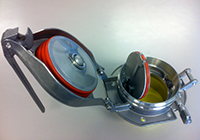
WSAWaste  Drain Valve200West Star Aviation recently announced they are now offering a Waste Drain Valve Modification for Hawker 800, 800XP, and 850XP.

The valve is manufactured and certified under FAA Parts Manufacturer Approval “PMA” and replaces the factory installed valve, which allows leakage and the potential for corrosion.

The factory-installed valve on the Hawker 800/800XP/850XP aircraft requires a T-Handle tool to remove the secondary pressurization plug or donut. If this plug is re-installed incorrectly, or in some cases not installed at all, the opportunity for leakage is greatly increased. This presents the possibility of the user being soaked during servicing as well as a potential risk for corrosion damage.

In addition, if the plug is missing, the MMEL for the Hawker states the aircraft is restricted to unpressurized flight and a ceiling of 15,000 ft. until it is replaced. This can cause dispatch problems of hours or days if the aircraft is in a part of the world where parts support is difficult.

“Most Hawker operators are familiar with the unpleasant task of draining their lavatory waste tank,” said Kendall Kreiling, Hawker program manager, West Star. “We can install a significantly improved version of the valve, which will eliminate the corrosion and downtime risk, as well as make the whole process much simpler for operators.”

The new valve features a spring-loaded internal fluid valve that opens with the small external level after the ground service cart duct is connected. This eliminates the mess if the tank valve leaks. Closing the internal valve is as simple as closing the cap with the over-center lever.

Gulfstream Establishes College Scholarship for WMAA Students

Gulfstream recently established a four-year college scholarship for eligible seniors attending West Michigan Aviation Academy (WMAA) in Grand Rapids. The Gulfstream Aerospace Scholarship begins with the class of 2014, the school’s first class of graduating seniors.

Gulfstream will award a $60,000 scholarship to one WMAA graduating senior each year from 2014 to 2017, totaling $240,000. Students will be selected on the basis of financial need, academic performance and enrollment in an aviation-related degree path at an accredited higher education institution.

“We are thrilled to partner with the West Michigan Aviation Academy to help foster future aviation leaders,” said Jennifer Giffen, vice president, Human Resources, Gulfstream. “Gulfstream is committed to advancing education and cultivating the talent our industry will need as the business-aviation market continues to grow.”

WMAA is a tuition-free public charter high school that offers a unique aviation education, along with a rigorous academic curriculum. The school opened in the fall of 2010 with 80 freshmen and now has 400 students. More than 70 seniors are expected to graduate in spring 2014.

“We are grateful to Gulfstream for this support of our students and our school,” said Patrick Cwayna, chief executive officer, WMAA. “It is WMAA’s mission to prepare our students for successful careers in aviation, and this scholarship will further advance that career path after graduation.”

In the addition to the WMAA scholarship, Gulfstream supports a number of educational initiatives focused on science, technology, engineering and math (STEM) learning, from on-site aviation career days to college internship and co-op opportunities.