Merlin Achieves FAA Approval for Custom Remote Data Concentrator

Merlin Achieves FAA Approval for Custom Remote Data Concentrator

Merlin has received Federal Aviation Administration (FAA) Technical Standard Order (TSO) authorization for its custom remote data concentrator (RDC), developed in collaboration with Shadin Avionics. This FAA approval supports Merlin’s ability to create certified advanced automation for an aircraft platform and marks a significant milestone in the ongoing flight test campaign of its certification-ready autonomy platform.

Designed to support the Merlin Pilot’s advanced automation capabilities, the RDC ingests analog data from existing and new aircraft sensors, converts it to a digital format, and transmits it to Merlin’s flight control computers. Merlin collaborated closely with Shadin Avionics to define the system, hardware, and design specifications. Receiving the FAA’s TSO authorization confirms that Merlin’s custom RDC meets rigorous airworthiness standards for both civil and military aviation applications, and once certified, is adaptable for various aircraft types and classes, including the C-130J and the KC-135.

“Our team is meeting technical milestones regularly, which significantly advances the Merlin Pilot towards certification while enhancing aviation safety and efficiency,” said Matt George, CEO and founder of Merlin. “The FAA’s authorization of our RDC is a major achievement in our Supplemental Type Certificate (STC) program, reinforcing the strength of our collaboration with Shadin Avionics and our commitment to the highest aviation standards. This approval is a critical step towards integrating safe and reliable autonomy into both civil and military airspace.”

HAECO Supports MSC Air With Line Maintenance Services in Hong Kong

HAECO Supports MSC Air With Line Maintenance Services in Hong Kong

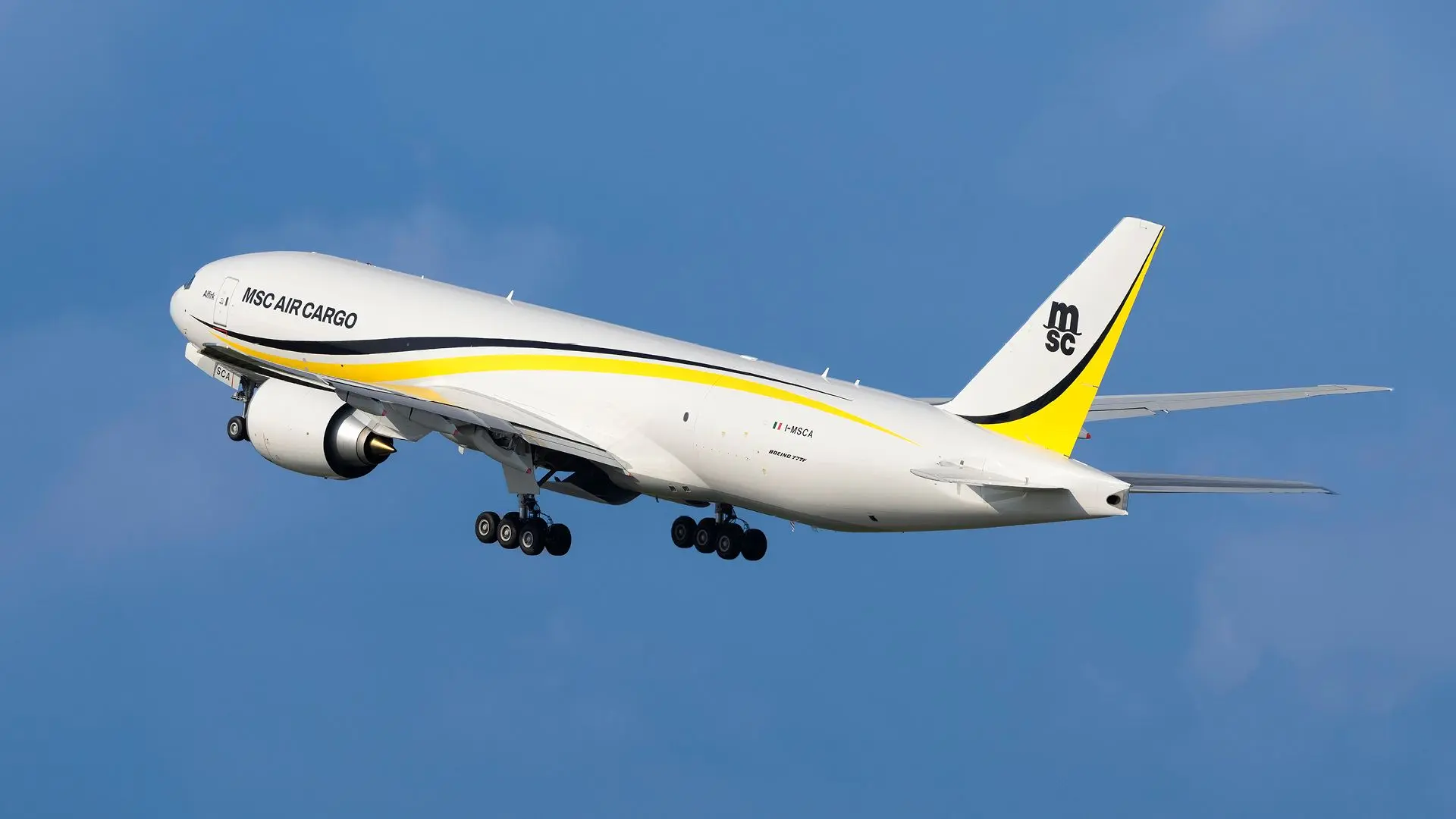
HAECO announced a new line maintenance agreement with MSC Air. MSC Air is a Milan-based freight carrier that now operates under the holding company, MSC Air Cargo. Under this agreement, HAECO will provide MSC Air with comprehensive line maintenance services for its new fleet of Boeing 777-200LRF freighter aircraft at Hong Kong International Airport, the busiest cargo airport in the world.

HAECO says it is uniquely positioned to support the operational performance of MSC Air’s expanding fleet. HAECO’s line maintenance solutions at its Hong Kong base will be a robust foundation as MSC Air grows its cargo network and services under the MSC Air Cargo umbrella.

“We are thrilled to partner with MSC Air as their line maintenance provider in the strategic location of Hong Kong, the world’s busiest cargo hub,” said Gerald Steinhoff, chief commercial officer at HAECO. “By leveraging HAECO’s industry-leading capabilities and expansive line services footprint both in Hong Kong and the Chinese Mainland, we look forward to becoming a trusted partner to MSC Air as they continue to expand their competitive cargo solutions.”

Airhub Aviation Strengthens Asset Management and MRO Services in Lithuania

Airhub Aviation Strengthens Asset Management and MRO Services in Lithuania

As airlines and lessors face ongoing maintenance capacity shortages, Airhub Aviation, part of GetJet Aviation Holding, is expanding to meet growing demand. The Lithuania-based company, specializing in aviation asset management, component trading, and aircraft transitions, has launched new MRO operations at Siauliai International Airport (SQQ), Lithuania.

Oleg Novak
Oleg Novak

With the global aircraft fleet projected to grow by 28% over the next decade, Airhub Aviation is adding MRO capacity in Northern-Eastern Europe. “As the global fleet matures and stays in service longer, maintenance needs are evolving beyond scheduled checks. More lessors, asset owners, and operators are turning to MRO facilities for bigger maintenance scopes, such as second 12-year checks. At Airhub Aviation, we see a growing demand for flexible MRO solutions that go beyond scheduled maintenance, and we are ready to meet that need. Therefore, we are adding MRO capacity in Lithuania,” said Oleg Novak, CEO of Airhub Aviation. So far, Airhub Aviation maintains it is the only provider in the region to offer new MRO capacity.

The facility enhances Airhub Aviation’s ability to handle aircraft checks and (re)deliveries, aligning with its strategy to support its owned fleet as well as partner airlines and lessors. “With aircraft replacement cycles extending and mid-life aircraft in high demand, efficient transitions and technical support are more critical than ever. Our MRO facility allows us to better serve our clients by integrating maintenance into our broader asset management expertise,” Novak added.

Airhub Aviation’s first MRO season was highly successful, completing over 17 maintenance inductions, including seven heavy checks on A320ceo aircraft. The company supports eight CAMO clients, manages five line stations and oversees component repair management for over 100 customers. Its client base includes World Star Aviation, GA Telesis, TrueNoord and others.

“With the global fleet aging and quick replacements not always possible, the demand for comprehensive maintenance services is rising. Our facility in Lithuania enables airlines and lessors to prepare aircraft for sale, lease, or their next mission with minimal downtime, offering EASA compliance modifications, LOPA retrofits, and engine swaps — all under one roof,” Novak said.

Located in Northern–Eastern Europe, Siauliai International Airport (SQQ) offers two of the longest runways in the region (3.5 km each) and operates as a dual-use civilian and NATO military facility, ensuring 24/7 access and high-security infrastructure.

“Our presence in Lithuania strengthens our ability to support fleet operators across Europe and beyond,” said Novak. “With well-developed transport links and proximity to major airline hubs, SQQ is an ideal location for aviation asset management and maintenance operations.”

The Siauliai MRO facility, completed in 2023, is one of the most modern MRO centers in Northern–Eastern Europe. It has the capacity to accommodate five narrowbody aircraft simultaneously or two narrowbody aircraft and one widebody aircraft, including models up to the size of a Boeing 747-8, Airbus A350-1000 or similar. This 183,000-square-foot facility serves as a one-stop shop for maintenance services, offering warehouses, workshops, and office spaces to provide airlines and lessors with streamlined and efficient maintenance solutions.

Intelligent Energy Safety Insight Paves the Way for Hydrogen Fights in the U.K.

Intelligent Energy Safety Insight Paves the Way for Hydrogen Fights in the U.K.

A new partnership between fuel cell pioneer Intelligent Energy (IE) and the Civil Aviation Authority (CAA) is bringing the promise of zero-emission hydrogen-powered flights in the U.K. a step closer.

The collaboration will play a key role in ensuring the safe operation of the first generation of fuel-cell-powered passenger aircraft that are predicted to take to the skies this decade.

Loughborough-based Intelligent Energy, a global leader in hydrogen fuel cell technology for more than 20 years, made history in 2008 by partnering with Boeing to achieve the first manned flight powered by a fuel cell.

The company continues to push the boundaries of hydrogen aviation, with innovations including a proprietary water injection cooling system that delivers unrivalled power density.

IE’s 300kW IE-FLIGHT 300 (F300) product, launched in July 2024, has been designed to meet the needs of the first commercial zero-emission aircraft. It will power the Part 23 aircraft (with up to 19 seats) and electric vertical take-off and landing (eVTOL) aircraft that are set to transform urban air mobility. First deliveries are planned for 2027.

IE has been selected by the CAA to contribute to the second round of its U.K. Hydrogen Challenge, a pivotal initiative preparing the aerospace industry for the transition to hydrogen as a zero-carbon aviation fuel. IE’s primary role will be to advance the safety and certification standards for fuel cell-based propulsion systems, ensuring their compliance with aviation regulations and expediting their integration into commercial use.

Jonathan Douglas-Smith, head of business development for IE-FLIGHT at Intelligent Energy, emphasized the significance of the partnership. “The U.K. is on track to lead the world in hydrogen fuel systems, but achieving zero-emission aviation requires more than just technological breakthroughs — it demands close collaboration between innovators and regulators,” Douglas-Smith said. “With our deep expertise in fuel cell design, manufacturing and real-world applications, we are uniquely positioned to bridge this gap. Our involvement in the U.K. Hydrogen Challenge keeps us at the forefront of zero-emission aviation while also shaping the future regulatory landscape for sustainable flight.”

The U.K. Hydrogen Challenge was launched in 2024 and trials in this second phase will run for three years.

“The long-term nature of the collaboration reflects the significance of the opportunity,” Douglas-Smith added. “Ultimately, this work will be instrumental in refining hydrogen fuel cell systems to meet aviation safety standards and accelerate their certification. We’re proud of our role in the project, which helps keep the U.K. a world-leader in hydrogen propulsion.”

Innovative Solutions & Support Unveils Next-Gen Prodigy 3ATI Integrated Standby Unit

Innovative Solutions & Support Unveils Next-Gen Prodigy 3ATI Integrated Standby Unit

Innovative Solutions & Support (IS&S) has introduced the Prodigy 3ATI Integrated Standby Unit (ISU). The company call it “a breakthrough in standby instrumentation that enhances flight safety, reliability and efficiency for both fixed-wing and rotary aircraft.”

When primary systems fail, pilots rely on standby instruments to maintain control and ensure a safe flight. The IS&S Prodigy 3ATI ISU consolidates essential flight data into a compact, high-performance display system, setting a new standard in aviation instrumentation. Designed as a direct form, fit and function replacement for legacy standby systems, the ISU simplifies installation while delivering unmatched performance.

The unit presents critical flight information — including altitude, attitude, airspeed, slip/skid, and navigation data — in a familiar Primary Flight Display format. Pilots benefit from an advanced LCD screen with full LED backlighting, ensuring exceptional readability even in direct sunlight. An ambient light sensor seamlessly adjusts brightness, enhancing visibility in all lighting conditions. At the core of the Prodigy ISU is an advanced Inertial Measurement Unit that provides precise attitude and heading data. When paired with an optional air data module, the system independently calculates altitude, airspeed, and Mach number, offering pilots reliable information in critical moments.

Built for versatility, Prodigy 3ATI offers both internal and external magnetometer interfaces and includes Directional Gyro mode as well as an optional autothrottle control capability. Its intuitive user interface and customizable options make it adaptable to a wide range of mission profiles. Prodigy is a compact Level A hardware/software 3ATI display, the unit maximizes space efficiency while maintaining industry-leading reliability. Certified to DO-160G and RTCA DO-178C Level A standards, it meets the highest levels of safety and performance.

Prodigy 3ATI comes with a five-year warranty and delivers long-term reliability and reduced maintenance costs. Its Installation Configuration Module simplifies integration, storing critical operational data such as static source error correction and aircraft-specific parameters. Additional configurable options, including NVIS compatibility and standby radio management, make it a highly adaptable solution for diverse aviation needs.

The IS&S Prodigy 3ATI Integrated Standby Unit is available for commercial, business, and military aviation applications.

StandardAero Appoints Bondada to VP, Investor Relations

StandardAero has appointed Rama Bondada to serve as vice president, investor relations, as of March 17, 2025.

In this new role for StandardAero, Bondada will be responsible for developing and executing a comprehensive investor relations function and program. He will take the lead in maintaining effective relationships with the investment community and ensuring consistent and timely communication of financial results for the company. Bondada will report to Dan Satterfield, chief financial officer of StandardAero and will be located at the company’s Scottsdale, Arizona headquarters.

Prior to joining StandardAero, Bondada served as vice president, investor relations, corporate strategy and U.S. corporate development for Lilium Aviation, where he also served as interim CFO prior to its recent privatization. Bondada has more than 15 years of experience in equity investing at several U.S. asset management firms such as First Manhattan, Balyasny Asset Management and Lord, Abbett and Co. Prior to his buy-side career he spent five years in investment banking and sell-side research at Royal Bank of Canada and Macquarie Capital.

His investment specialty has primarily focused on the aerospace and defense sector in addition to global industrials, transportation and materials. Bondada also worked for Lockheed Martin and Honeywell Aerospace.

“Rama will play a critical role in articulating the StandardAero narrative, vision and strategy, and educating the investor community in our inaugural year as a publicly traded company,” said Satterfield. “His deep knowledge and experience with financial, industrial and aerospace markets, brings immediate and relevant capabilities to StandardAero, along with the know-how to raise the bar for our investor relations program and profile.”

Trax and Cathay Pacific Sign Digital Transformation Deal

Trax and Cathay Pacific Sign Digital Transformation Deal

Trax announced that Cathay Pacific selected Trax to power its engineering department’s strategic digital transformation.

Trax’s comprehensive, web-based eMRO solution, fully managed cloud hosting services, and a selection of its innovative eMobility applications, including AeroDox, VisualCheck, Line Control, TaskControl, and eContent Control, will be at the center of Cathay Pacific’s shift towards real-time, data-driven maintenance operations. Trax’s advanced mobile and cloud-based solutions will provide the airline with instant access to critical operational data, enabling informed decision making, improved coordination, and increased productivity, all in a paperless environment.

“Trax is honored to be at the center of Cathay Pacific’s Engineering Department’s digital transformation,” said Andrew Schmidt, executive vice president of Trax. “We are delighted that another Tier 1 operator has joined our Trax community to experience enhanced airworthiness control, integrated planning, streamlined processes, and a fully digital and paperless maintenance environment. Our eMRO solution will enable Cathay Pacific to improve its overall fleet performance and integrate innovative practices into its daily operations.”

“Trax’s advanced maintenance solutions will modernize our operations, providing improved coordination and greater efficiency to support our commitment to safety, operational reliability, customer centricity, and innovation,” said Keith Brown, Cathay’s director of engineering. “The implementation of Trax’s solutions will further enhance Cathay Pacific’s goal of being an industry digital leader.”

Turkish Technic and Air India Express Expand Partnership

Turkish Technic and Air India Express Expand Partnership

Turkish Technic has signed an agreement with Air India Express, subsidiary of Air India group, covering their Boeing 737-8 and 737-10 fleet. The agreement includes the component support and solution needs of 190 Boeing 737-8 and 737-10 aircraft, enabling Air India Express to benefit from extensive component services such as component pooling, repair, overhaul, modification, and logistics services of Turkish Technic. Leveraging its extensive global supply chain and technical expertise, Turkish Technic continues to enhance the operational efficiency and fleet reliability of Air India Express’s fleet.

“We are happy to further strengthen our partnership with Air India Express through a new agreement. The continuation of our cooperation is a testament to our reliability in component support, supply, and solution services. We are confident in our capabilities and global supply chain network to continue enhancing their operational efficiency. We thank Air India Express for choosing us as their trusted solution partner. We are excited to contribute to the elevation of Indian aviation,” said Mikail Akbulut, CEO and board member of Turkish Technic.

Aloke Singh, managing director, Air India Express, added, “We are happy to have Turkish Technic as our partner for the component support and solution service for the B737-8 and B737-10 aircraft. The collaboration will further bolster our repairs and maintenance competencies for the airline’s rapidly growing B737 family of aircraft and enhance our reliability and availability of components for aircraft operations.”

Lufthansa Technik Malta to Build New Hangar for 787 Dreamliner Cabin Modifications

Lufthansa Technik Malta is expanding its location and capacities. From autumn 2026, a new 6,400-square-meter hangar will be used to carry out base maintenance services, particularly cabin modifications on 787 Dreamliner aircraft. As a Boeing-licensed service center, Lufthansa Technik is the only MRO (maintenance, repair and overhaul) provider worldwide authorized to perform the combination of 787 cabin modification engineering services and their implementation. The new building will provide space for one widebody aircraft. Additionally, three parking spots for narrowbody aircraft will be established. All this will create around 70 new jobs. Lufthansa Technik recently acknowledged the signing of the expansion agreement with representatives in Malta.

“With the expansion of our base maintenance service center in Malta, we are strengthening the global network of Lufthansa Technik and, in addition to the previously announced construction of two new facilities in Portugal and Canada, we have achieved another major milestone in our corporate strategy within a few months,” said Harald Gloy, chief operating officer at Lufthansa Technik. “Lufthansa Technik Malta will be the first location worldwide where Lufthansa Technik will carry out work on the 787 Dreamliner as a Boeing-licensed service center for cabin modifications. This will not only create new options for our customers, but also highly qualified jobs in Malta.”

With the addition of a new hangar, which will be attached to the existing buildings, Lufthansa Technik Malta will have a total of four hangars capable of carrying out MRO on nearly all commercial Airbus aircraft — except the A380 — as well as on the Boeing 787 Dreamliner. The new hangar is expected to be operational by autumn of 2026, following a construction period of 18 months.

“The context of this investment is the positive economic performance of our country as since 2013 the economy has grown by 86 percent to well exceed the average growth in the Euro Zone which stands at 14 percent,” said Robert Abela, the Maltese Prime Minister. “This new project is not only a testament to the resilience of our economy but also a reflection of the commitment to excellence that characterizes our workforce and our nation. Thank you, Lufthansa Technik for your trust in Malta as a strategic partner for your future growth — you will find us as resolute supporter and partner — let us embrace this moment with optimism and resolve.”

Maria Cilia, chief executive officer of Lufthansa Technik Malta, said, “Today marks a historic moment for Lufthansa Technik Malta as we embark on a transformative journey that will shape the future of our company. This significant project is more than just an investment — it is a testament to our commitment to growth, innovation, and excellence in aviation maintenance. Together with my 570 colleagues here in Malta, I take immense pride in seeing our site expand into new frontiers. The launch of our 787 Dreamliner cabin modification projects represents an exciting evolution for our operations, building on our proven expertise in base maintenance for this aircraft type. As CEO, an engineer, and a proud Maltese, I see this expansion as an opportunity that extends beyond our company. It strengthens Lufthansa Technik Malta, creates opportunities for our employees, enhances the experience for our customers, and reinforces Malta’s position as a thriving aviation hub. This is not just about today — it is about shaping the future of aviation in Malta.”

The company will hire an additional 70 employees by the time the new hangar becomes operational, increasing the total number of staff to nearly 650.

Last year, Lufthansa Technik received Boeing’s license to carry out cabin modifications on 787 Dreamliner aircraft. Since then, preparations have been underway. The first cabin modification is scheduled to start this year in one of the existing hangars in Malta. As a Boeing-licensed service center for 787 cabin modifications, Lufthansa Technik is authorized to design new cabin interiors, provide the corresponding engineering, and carry out the integration according to customer requirements. With the license granted by Boeing, Lufthansa Technik will also manage the certification process.

GE Aerospace to Invest Nearly $1B in U.S. Manufacturing in 2025

GE Aerospace says it plans to invest nearly $1 billion in its U.S. factories and supply chain to strengthen manufacturing and increase the use of innovative new parts and materials needed for the future of flight. This new investment is nearly double last year’s commitment and will help increase engine safety, quality, and delivery, benefitting more than two dozen communities across 16 states, it says. The company also announced it will hire around 5,000 U.S. workers this year, including both manufacturing and engineering roles.

“Investing in manufacturing and innovation is more critical than ever for the future of our industry and the communities where we operate,” said H. Lawrence Culp, Jr., chairman and CEO of GE Aerospace. “We are committed to helping our customers modernize and expand their fleets while scaling technologies that will truly define the future of flight. Together, this will keep the United States at the forefront of aerospace leadership.”

GE Aerospace is growing its capacity and expanding several key sites, especially those that support the production and assembly of the narrowbody CFM LEAP engine, where deliveries are expected to increase by 15-20% this year. The company says these investments, combined with GE Aerospace’s proprietary lean operating model, FLIGHT DECK, are improving safety, quality, delivery and cycle times. Some of these investments include:

$113 million in Greater Cincinnati: Facility upgrades and additional equipment for several sites in the area that produce, test, and assemble many of the company’s commercial and military engines.

$70 million in Muskegon, Michigan: Breaking ground on an expansion to produce parts for the hot section of the engine.

$16 million in Durham, North Carolina, and $5 million in Lafayette, Indiana: Additional equipment to support the assembly of commercial engines, including LEAP.

$13 million in West Jefferson, North Carolina: Expanding the building to increase production of key parts of the engine.

$200 million investment in military engine production: The company is investing in sites, including Lynn, Massachusetts, and Madisonville, Kentucky, to get ready for the new T901 Black Hawk and Apache helicopter engine and continue producing other military engines.

The company’s investments are also scaling the production of parts made from new materials and advanced manufacturing processes that provide engines with more range, power and efficiency. This includes additive manufacturing, or 3D printing, which reduces part count, increasing fuel efficiency and durability while providing greater design freedom as well as ceramic matrix composites (CMCs). CMCs are one-third the weight of traditional materials but can operate at up to 500 degrees hotter, meaning greater power and durability for engines. Among the investments to further scale these technologies include:

  • $51 million in Auburn, Alabama: Additional 3D printers, upgrades to existing equipment and tooling to increase capacity and ensure quality.
  • $14 million in West Chester, Ohio: Additional 3D printer, industrial furnace, and upgrades to facility to increase capacity.
  • $22 million in Huntsville, Alabama: Additional machines to produce materials that are the building blocks for ceramic matrix composite engine parts.
  • $20 million in Asheville, North Carolina: Additional equipment to produce ceramic matrix composite engine parts, new inspection equipment, and advanced machines that can shape metal parts to precise specifications.
  • $11 million in Batesville, Mississippi: Industrial oven, precision measuring tools, high-precision machines, and inspection technology to maintain quality.

The almost $1 billion investment includes $100+ million dedicated to the company’s external supplier base, providing investments to ensure suppliers are using the newest tools to produce parts, further reducing defects and supply chain constraints.

Last year GE Aerospace says it hired more than 900 engineers and 1,000 new manufacturing workers, which will increase to 5,000 this year. GE Aerospace and its Foundation will also donate $2.3 million to more than a dozen communities to support workforce development skills training.