Continental Aerospace Technologies Launches Innovative, User-Focused Website, Applications and Support

Continental Aerospace Technologies announced its newly released website, building on a legacy of innovation. This redesigned platform will deliver a streamlined and intuitive experience for pilots, aircraft owners, and maintenance providers around the world. With a new Illustrated Parts Catalog (IPC), Titan Builder, and Lean of Peak and FADEC simulator, these new applications underscore Continental’s dedication to innovation and exceptional customer support.

The new www.continental.aero website is fully responsive on all devices and showcases a fresh design that is user-friendly and easy to navigate. The User Interface (UI) emphasizes the visual arrangement and interactive features, while the User Experience (UX) ensures users can easily and efficiently locate the technical information to support their engine and spare parts. Whether viewed on desktop, tablet, or mobile, the platform assures a consistent and easily accessible experience.

The launch of the new website introduces a suite of interactive tools, including our popular FADEC and Lean of Peak simulators that allow users to explore engine performance. Pilots can also now customize their own experimental engine with the TITAN Engine Builder. This application simplifies the configuration process and allows users to more easily build and design their ideal experimental engine for their airframe.

Another upgraded feature of the platform is the completely redesigned Illustrated Parts Catalog (IPC), with an enhanced, visually intuitive interface that allows users to quickly and precisely identify and locate genuine Continental and PMA aftermarket replacement parts and components. This improvement streamlines search and navigation functions to help users reduce downtime during maintenance intervals.

With new website enhancements and a strengthened partner support network in place, Continental is also actively advancing its infrastructure to support 24/7 customer service. While around-the-clock support is being phased in, this continuous support model is being built to ensure critical customer needs are addressed quickly, regardless of the time zone. Backed by a dedicated global team, Continental remains committed to delivering a responsive, personalized service that meets the evolving needs of aircraft owners and mechanics.

“Our new tools reflect our commitment to innovation and delivering an outstanding customer experience,” said Karen Hong, president and CEO of Continental Aerospace Technologies. “By combining advanced technology with a strengthened global support network, we are giving our customers greater access to technical information, wherever and whenever they need it. These tools are developed with our users at its core, offering enhanced resources and the opportunity to engage with us in a new way.”

To explore the new website and tools, visit www.continental.aero

Goodyear to Donate Last Remaining GZ20-Era Blimp Gondola to the EAA Museum for a Children’s Exhibit

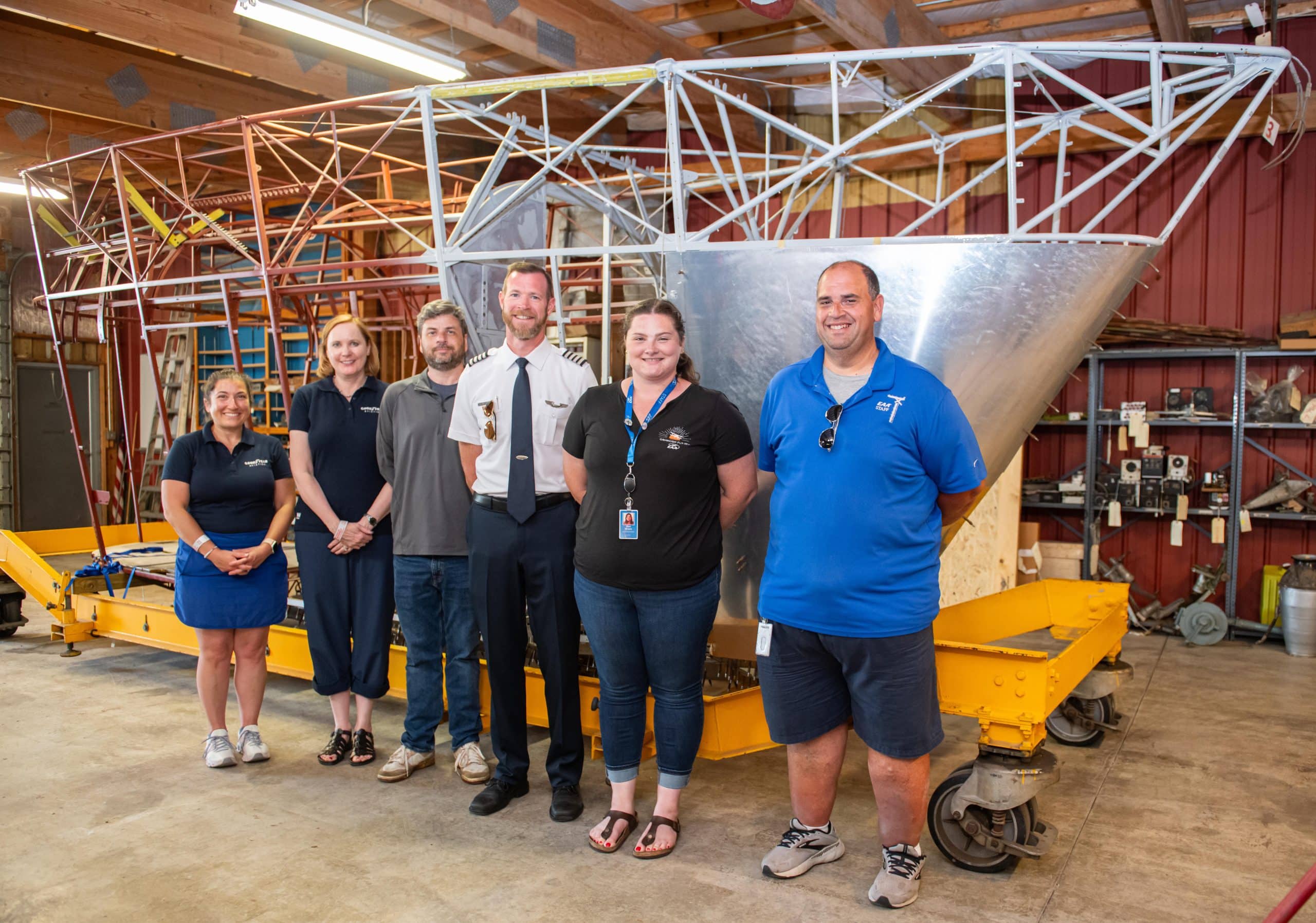
On opening day of the 2025 Experimental Aircraft Association (EAA) AirVenture Oshkosh show, The Goodyear Tire & Rubber Company announced that it will donate its last-remaining blimp gondola frame to the EAA Museum as part of a new children’s exhibit.

The gondola frame is from Goodyear’s GZ20 model era of blimps that spanned nearly 40 years. In that time period, as one blimp retired, its gondola was often refurbished for a new blimp. The gondola frame being donated to the EAA Museum was previously used on the Europa, Goodyear’s Blimp that flew throughout Europe in the 1980s, and on the Florida-based Stars and Stripes in the early 2000s. This tradition ended in 2011 when Goodyear began the transition to the New Technology (NT)
semi-rigid airship platform that remains in place for its fleet of airships still today.

As part of this year’s celebration of the Goodyear Blimp’s 100th anniversary, this gesture marks another way for Goodyear to preserve the history of its airships program and carry the legacy of the Goodyear Blimp forward for future generations.

“As we celebrate our blimp program’s 100th anniversary, there’s no better way to honor its legacy than by inspiring the next generation of aviation enthusiasts,” said Michael Dougherty, Goodyear’s chief pilot. “We hope this exhibit sparks curiosity and dreams of flight on aircraft of all kinds in countless children into the future.”

“Goodyear’s Blimp flying has been an iconic part of aviation for a century, so this donation is a great fit as part of our museum’s mission to tell the story of flight,” said Chris Henry, EAA Aviation Museum manager. “Just as Goodyear Blimps have brought fascination with flight, this donation will be part of a future exhibit that inspires those with aviation dreams.”

Limited-Edition Keepsake Item Gives Fans a Once-in-a-Lifetime Chance
to Own a Piece of the Goodyear Blimp

Along with the gondola donation, Goodyear is also offering fans the unique chance to take home a piece of the Goodyear Blimp. The Spirit of Goodyear keepsake item includes a genuine piece of envelope that flew with the Spirit of Goodyear blimp across North America from 2000 to 2014, wrapped in a commemorative 100th anniversary box. Christened by NASA Astronaut and the first American woman in space Sally Ride in March of 2000, the Spirit of Goodyear went on to become one of Goodyear’s most decorated blimps. It holds the Guinness World Record for the longest continuously operated airship, and it was the first blimp to provide aerial TV coverage of a sporting event in high definition. When the Spirit of Goodyear retired in 2014, Goodyear donated its gondola to the Crawford Aviation Museum in Cleveland but retained its envelope, which is now a piece of this limited-edition keepsake item.

The Spirit of Goodyear keepsake item is now available for purchase while supplies last by visiting the Goodyear Fan Store: Goodyear | Blimp Keepsake Box. A portion of the proceeds will be donated to the EAA Museum to contribute to the children’s museum build.

Goodyear’s 2025 Presence at EAA AirVenture Oshkosh
This year, Goodyear Aviation will, once again, be located at booth (#489), where the latest aviation tires and technology will be on display. Additionally, as part of the Goodyear Blimp’s centennial celebrations,
Goodyear is sending two blimps to Oshkosh for the first time. Wingfoot One, with its vintage wrap inspired by the very first branded Goodyear Blimp Pilgrim, will participate in daytime airshows throughout the week, and Wingfoot Two, with its LED sign, will participate in nighttime airshows.
Fans can follow along @Goodyear and @GoodyearBlimp on social media for updates throughout the week.

Nighthawk Flight Systems Unveils Guardian Avionics System

Nighthawk Flight Systems, Inc., a developer of advanced compact federated avionics, is unveiling its Guardian large format glass cockpit avionics system. Unlike any system currently on the market, Guardian is a lightweight, customizable, and easily expandable system that operates seamlessly with the owner’s current cockpit avionics while providing unmatched situation awareness and reduced pilot workload.

“We developed Guardian to give general aviation aircraft an affordable system with all the functions and features of advanced glass systems, but better. We provide a much lighter, more affordable system with the best, most realistic synthetic vision on the market,” said Nighthawk Flight Systems, Inc. CEO Paul Martin. “We offer general aviation pilots, owners, and operators a far superior fully customizable glass cockpit, with unmatched simulated vision. We use “Smart I/O” to operate seamlessly with existing systems and sensors, on a single or multiple touchscreen displays.”

Unmatched Graphics

Guardian features revolutionary 3D imagery never before experienced on the market. The graphics display consolidates multiple sources of obstacle, flight environment, traffic, weather, terrain, satellite imagery, and more, displaying it in a high-resolution real-world 3D view on programmable touchscreen displays. Unlike other synthetic vision, Guardian’s imagery provides high detail that dramatically improves definition and situation awareness.

Light, Compact Design

Up to 50% lighter than current, equal-capability avionics system, the ingenuity behind Guardian is its compact computing center called the NEST. The NEST can be installed anywhere in the aircraft, connected to the lightweight, thin, touchscreen Guardian panel display through a single cable. The NEST houses individual ‘blades’ that provide mission computing (the MCU), air data/attitude/heading reference system (ADAHRS), and smart I/O (programmable input/output to connect to existing avionics). The MCU contains all computational and graphical information for display. The smart I/O pulls together information from existing onboard avionics including autopilot, GPS, radios, navigation aids, weather, ADS-B In, and more for access on the programmable displays.

The NEST can be fitted with additional blades for added capabilities not currently installed in the aircraft or to replace existing avionics such as radios, navigation, ADS-B, transponder, GPS, and more. Unlike a traditional multifunctional display (MFD) system, this allows individual capabilities to be quickly exchanged or upgraded without the need for a full system upgrade, leading to considerable savings down the line. The display can also be replaced independently if desired.

See a live demonstration of the Guardian display at Oshkosh 2025 in the Nighthawk Flight Systems space 326.  Contact Randy Jones, VP of sales and marketing for scheduling.

New Authorized PC-24 and PC-12 Service Center in Lugano Agno in Southern Switzerland

Pilatus has accredited Dassault Aviation Business Services at Lugano Airport in Ticino as an Authorized Service Center for the PC-12 and PC-24, specializing in line maintenance services. The company already offers maintenance and repair services for all Pilatus business aircraft at its Geneva site.

The accreditation of the Dassault Aviation Business Services site in Lugano marks a further expansion in the Pilatus network of Authorized Service Centers. PC-12 and PC-24 customers now enjoy even faster and more flexible access to line maintenance and services, and benefit from even better support for their Pilatus aircraft. 

André Zimmermann, vice president business aviation at Pilatus, points out: “Demand for our PC-12 and PC-24 Super Versatile Jet continues to grow worldwide, which is why we are constantly expanding our support network. We are confident that our ongoing successful partnership with Dassault Aviation Business Services and accreditation of the site at Lugano Airport will deliver a further improvement in our customer service.” 

“Both the PC-12 and the PC-24 are a popular choice for private, business and charter operations in Europe. We look forward to building on our longstanding relationship with Pilatus and to providing support for these fantastic aircraft”, adds Cyrille Pillet, vice president customer support & technical services at Dassault Aviation Business Services. 

Advanced Motion Control Components for Critical Aerospace Applications

Advanced motion control technologies are essential to modern aerospace design, supporting a wide range of safety-critical and comfort-driven applications. In aerospace, motion control components—such as gas springs, actuators, and dampers—are integral to nearly every commercial aircraft, rocket, satellite, and space vehicle. These critical elements support flight safety and transport functions, from the dependable deployment of landing gear and cargo doors to the smooth, ergonomic operation of seating for pilots and passengers.

However, for aerospace manufacturers achieving the rigorous safety, reliability, and performance standards often requires more than standard off-the-shelf components—it demands specialized motion control solutions designed to deliver reliable performance under unique specifications and extreme conditions. “In many cases, the components must be fully or partially customized to meet specific application requirements. Even when development begins with a standard part, various modifications are frequently necessary such as changes in stroke length, force calibration, material composition, damping characteristics, and mounting hardware,” says Brian Ingoldsby, engineering manager at Bansbach Easylift of North America Inc., a global supplier of motion control devices, systems, and components since 1919.

According to Ingoldsby, the process of modification or customization begins with evaluating the specific functional requirements, such as whether the component must counterbalance a load, provide damping, or perform consistently under defined temperature, pressure, or altitude conditions. Material selection is particularly important, as components must often meet weight, corrosion resistance, and fatigue criteria unique to aerospace environments.

“In aerospace engineering projects, key design considerations typically include space constraints, force output, mounting geometry, material selection, and environmental exposure. These factors are assessed in close collaboration with the customer, often resulting in a fully customized product tailored to the exact specifications of the application,” says Ingoldsby.

The specialized motion control components also must meet all necessary testing and classification requirements to comply with FAA and EASA regulatory standards. Each part must meet the RTCA DO-160 testing standards, an international benchmark designed to ensure airborne equipment can withstand the harsh conditions encountered in aviation. This necessitates a deep understanding of certification protocols and the ability to manage the complete approval process.

For these reasons, a growing number of aerospace equipment designers are choosing to collaborate closely with motion control engineers from the earliest stages of a project. To facilitate such cooperation, leading companies like Bansbach assign dedicated engineers to provide input, explore design options, offer technical recommendations, and develop solutions that enhance overall system performance.

“The ultimate objective is to streamline the OEM’s design process, reduce their development time, and ensure that the final product meets the performance specifications,” says Ingoldsby.

Manual Motion Control

In aerospace systems, gas springs play a vital role in enabling safe, controlled, and ergonomic motion. From landing gear doors to access panels and cargo hatches that must remain safely open during maintenance or loading, gas springs provide the necessary force control and damping. Within the cabin, locking gas springs combine controlled motion with the ability to lock in a fixed position, a key feature in adjustable seating, stowable tray tables, and other reclining mechanisms.

Gas springs are also found on nearly every rocket, satellite, or space vehicle, as well as in equipment used for ground support and launch operations. One example is for separation events on rockets, where components are ejected during different flight stages. 

Dampers are widely used in aerospace applications to control motion, manage energy, and reduce vibration in various systems throughout an aircraft. Inside the cabin, dampers are used in seating mechanisms and overhead storage compartments to provide controlled motion. Dampers also play an important role in managing the operation of cargo doors, service panels, and passenger doors. Directional locking dampers allow manual force to override the position of the locking gas spring. This function supports both emergency use and maintenance operations.

Although gas springs and dampers share similar external appearances and basic operating principles across manufacturers, certain models are engineered with specialized design features that provide distinct advantages for aerospace applications.

Unlike some standard offerings that require OEMs to design around preset dimensions, Bansbach provides components that can be manufactured to match customer specifications. In this regard, Bansbach manufactures gas springs with rod diameters from 3 millimeters (0.12 inches) to 70 millimeters (2.75 inches), capable of lifting multiple tons.

Bansbach also incorporates innovative design elements into its products. These enhancements go beyond standard configurations and involve selection of materials, surface treatments, and internal components.

As with many aerospace components, aluminum is often selected due to its significant weight savings over steel.

Beyond material selection, advanced engineering features play a critical role in maximizing performance and extending product lifespan. For example, an integrated grease chamber can increase durability and support higher cycle counts than standard models. To further enhance longevity, the company applies a proprietary oven-cured surface treatment that improves corrosion resistance and creates a smooth, durable rod finish without compromising seal performance. As a result, treated gas springs typically last three to five times longer than conventional gas springs.

Along with mechanical durability, thermal performance is critical. Aerospace components must operate reliably across extreme temperature ranges. Consequently, additional considerations for aerospace applications include specialty seals and oils formulated for extreme environments. Components may need to withstand temperatures up to 200°C near engines, while others must perform reliably in subzero conditions. To ensure consistent performance across this wide temperature range, the company employs advanced seals engineered for both high- and low-temperature operation.

Automated Motion Control

Motion control components such as electric linear actuators provide precise, compact movement. Adoption within the aerospace sector remains limited. However, interest in the technology is steadily increasing and electric actuators hold significant promise for future aerospace applications.

Bansbach’s EasyE electric linear actuators are available in a range of lifting capacities, with customizable stroke lengths up to 1,500 mm and dynamic load capabilities up to 10,000 N. The linear design allows for a compact installation footprint, while available accessories—including controllers and handsets—simplify system integration. Turnkey actuator kits further streamline deployment by eliminating the need for separate component sourcing, programming, or integration.

The Value in High Quality Components

Using higher-quality, custom-engineered motion control components provides significant advantages for aerospace manufacturers. Whether through advanced gas springs, precision dampers, or electric linear actuators, the right components ensure that equipment will operate smoothly and reliably for the expected lifespan, while meeting the rigorous standards of modern aerospace.

By working closely with motion control experts, aerospace designers ensure components meet the highest safety standards, streamline certification, and reduce development risks.

Deadline Today for U. S. Agents for Service Designations

Today, July 7, 2025 is the deadline for U.S. Agents for Service on individuals with foreign addresses who hold or apply for certain certificates, ratings or authorizations.

The Federal Aviation Administration (FAA) and Department of Transportation (DOT) require individuals with foreign addresses, and no U.S. physical address of record on file with the FAA, who hold or apply for certain certificates, ratings, or authorizations to designate a U.S. agent for service of FAA documents.

The U.S. agent will receive service of FAA documents on the certificate holder or applicant’s behalf. This rule facilitates the FAA’s ability to accomplish prompt and cost-effective service of process and service of other safety-critical or time-sensitive documents to individuals abroad through service on their U.S. agents, the FAA says.

This final rule adds subpart C to part 3 of title 14 of the Code of Federal Regulations (14 CFR). Subpart C requires individuals who have a foreign address and no U.S. physical address of record on file with the FAA to designate a U.S. agent for service if they apply for a certificate, rating, or authorization issued under 14 CFR part 47, 61, 63, 65, 67, or 107, or hold a certificate, rating, or authorization issued under any of these parts.[1]

The U.S. agent will receive service of FAA documents on behalf of the certificate, rating, or authorization holder or applicant. This final rule facilitates the FAA’s ability to accomplish prompt and cost-effective service of process and service of other safety-critical or time-sensitive documents to individuals abroad through service on their U.S. agents.[2] This will conserve agency resources, ensure that lengthy delays in service of process do not compromise aviation safety, and provide individuals abroad with timely notice of FAA actions and the opportunity for more expedient due process.

Cirrus Invests $13M to Expand Grand Forks Manufacturing Facility

Cirrus Aircraft has announced the expansion of its Grand Forks manufacturing facility during a groundbreaking event. Cirrus will invest $13 million to add 30,000 square feet to the current 165,000 square foot manufacturing facility. The expansion will support Cirrus aircraft manufacturing their single-engine piston aircraft, the SR Series and their jet, the Vision Jet, with additional equipment, storage, technical tools as well as new jobs expected to be added over the next five years.

“We have worked closely with the Grand Forks legislature and community to invest in the growth and expansion of a facility that not only supports manufacturing the best-selling single-engine piston aircraft and best-selling jet—right here in Grand Forks,” said Zean Nielsen, CEO of Cirrus. “Cirrus is deeply committed to safety, innovation, quality and contributing to the long-term economic vitality of the region.”

Cirrus invites more people to experience personal aviation through safety, innovation and quality. The SR Series and Vision Jet are embedded with advanced systems, including the Cirrus Airframe Parachute System (CAPS) and Safe Return Emergency Autoland as standard equipment. The company offers a total safety solution from Cirrus Approach Flight Training to its worldwide Authorized Network of Flight Training and Service Centers. To date, Cirrus has delivered over 11,000 aircraft, and the total fleet has surpassed 18M flight hours.

The Cirrus Grand Forks expansion is expected to be completed in the second quarter of 2026.

ARSA Survey Reviews FAA’s “Methods, Techniques, and Practices” AC

On June 14, the Aeronautical Repair Station Association (ARSA) opened a short survey collecting industry feedback on FAA Advisory Circular (AC) 43.13-1B Acceptable Methods, Techniques, and Practices—Aircraft Inspection and Repair.

The FAA has engaged industry to help review the AC, which primarily supports independent mechanics, technicians, and repair stations maintaining general aviation aircraft. ARSA is collaborating with the Aircraft Electronics Association (AEA) to gather input ahead of an in-person meeting on July 15-16.

The agency’s review focuses on:

(1) Clarifying and revising the content.

(2) Eliminating redundancy.

(3) Updating for new technologies.

To complete the survey, maintenance professionals should visit arsa.org/ac-43_13_1 or click here to go directly to the questionnaire.

Cessna SkyCourier Marks Five Years Since First Flight of Clean-Sheet Aircraft

Textron Aviation is celebrating the five-year anniversary of the first flight of the Cessna SkyCourier, the company’s clean-sheet twin-engine, high-wing utility turboprop. This is a significant milestone for this high-performing aircraft which is being used by operators worldwide.

To support growing flight activities of the SkyCourier, the company is investing in a 52,000-square-foot expansion of a production flight test hangar in Wichita, Kansas. The expansion will add an additional six hangar bays to the north side of a facility on Textron Aviation’s East Wichita Campus.

“The versatility of the Cessna SkyCourier enables operators to tackle diverse mission profiles and operate in some of the most challenging environments in the world,” said Lannie O’Bannion, senior vice president, sales & marketing. “With two variants of the aircraft and the optional gravel and combi conversion kits, the SkyCourier has brought innovative solutions to our customers around the globe.”

The Cessna SkyCourier prototype first took flight on May 17, 2020. Since then, it has become a reliable solution for air freight, passenger, humanitarian and other special mission needs across the world with its ability to land on unimproved runways and transport passengers and cargo simultaneously.

Program Milestones

Recent program milestones include the first order from the Marshall Islands and first delivery to Canada. See below for additional milestones.

  • March 2022 – Earned FAA type certification
  • July 2022 – Certified in the Bahamas
  • September 2022 – Certified in Suriname
  • February 2023 – Optional Gravel kit offered
  • June 2023 – Certified in Brazil
  • August 2023 – Certified in Mexico
  • May 2024 – Certified in Australia
  • May 2024 – Combi conversion kit FAA certified
  • July 2024 – Certified in the Philippines
  • December 2024 – Certified in Canada

About the Cessna SkyCourier
The twin-engine, high-wing turboprop offers a combination of performance and lower operating costs for air freight, commuter and special mission operators.

The freighter variant is sized to handle up to three LD3 shipping containers with an impressive 6,000 pounds of payload capability. The 19-passenger variant includes crew and passenger doors for smooth boarding, as well as large cabin windows for natural light and views. Both configurations offer single-point pressure refueling to enable faster turnarounds.

The SkyCourier is powered by two wing-mounted Pratt & Whitney Canada PT6A-65SC turboprop engines and features McCauley Propeller Systems’ C779 propeller, a reliable 110-inch aluminum four-blade propeller, which is full feathering with reversible pitch, designed to enhance the performance of the aircraft while hauling tremendous loads. The SkyCourier is operated with Garmin G1000 NXi avionics and has a maximum cruise speed of more than 200 ktas and a 900 nautical-mile maximum range.

Cirrus Announces SR Series G7+ Featuring Safe Return Emergency Autoland

Cirrus announced the new SR Series G7+ featuring Safe Return Emergency Autoland by Garmin, the world’s first FAA-approved autonomous emergency landing system in a single-engine piston aircraft. With the integration of this technology, anyone in the cabin can activate Safe Return Emergency Autoland with the touch of a button in the event of an emergency, commanding the aircraft to navigate to a suitable nearby airport and land autonomously. This advancement in aviation safety provides pilots and passengers of the world’s best-selling high-performance single-engine piston aircraft with an automated emergency landing option in the event of pilot incapacitation or a similar in-flight emergency. Cirrus is currently delivering the SR Series G7+ with Safe Return™ Emergency Autoland.

The SR Series G7+ introduces more new features, including Automatic Database Updates enabled by Cirrus IQ PRO for pilot convenience, Runway Occupancy Awareness for safety and Smart Pitot Heat powered by the Perspective Touch+ flight deck for reduced pilot workload. Together, these features combined with Safe Return Emergency Autoland and the company’s signature Cirrus Airframe Parachute System® (CAPS), bring to market the SR Series G7+, a robust aircraft embedded with advanced technology, automation and safety innovations.

“We’re excited to introduce the SR Series G7+, the aircraft that anyone can land in the event of an emergency with the touch of a single button,” said Zean Nielsen, Chief Executive Officer of Cirrus. “As the largest personal aircraft manufacturer in the world, delivering approximately 600 SR Series aircraft per year, the addition of Safe Return™ Emergency Autoland on a single-engine piston aircraft brings technology previously only available on larger turbine and turboprop aircraft to a greater number of pilots, spouses and their passengers for added peace of mind. The SR Series G7+ launch, along with our expanding ecosystem and Cirrus IQ platform, underscores our commitment to safety and relentless pursuit of innovation.”

Cirrus has historically led the industry in making safety innovations such as the Cirrus Airframe Parachute System (CAPS) and now Safe Return Emergency Autoland as standard equipment. With over 10,000 SR Series aircraft manufactured and 17 million flight hours accumulated since 1999, Cirrus continues to grow the industry and invent solutions that make flying safer and more approachable.

Safe Return Emergency Autoland

The Safe Return Emergency Autoland system uses a combination of advanced sensors, sophisticated algorithms and automated flight control systems to enable the aircraft to autonomously land safely without pilot input. With a single push of a button, the system takes control of the aircraft, communicates with air traffic control, navigates to the nearest suitable airport while avoiding terrain and adverse weather, autonomously lands the aircraft bringing it to a complete stop, shuts down the engine and stops the propeller so that passengers can exit the aircraft safely.

Safe Return Emergency Autoland Activation:

  • Straightforward Activation: In the event of an emergency, the pilot or passengers can activate the system with a simple push of a button, which is centrally positioned in the aircraft’s cabin ceiling, initiating Safe Return Emergency Autoland.
  • Advanced Algorithms: The system is powered by sophisticated onboard sensors and algorithms that adapt to changing conditions and enable navigation through the airspace, calculate runway parameters, and detect real-time weather and terrain.
  • Fully Automated Flight Control: Safe Return Emergency Autoland autonomously controls the autopilot and engine to fly the aircraft and execute a safe landing sequence.
  • Air Traffic Control: The system continuously communicates with air traffic control during the flight and automatically switches to different frequencies as the aircraft travels to the most suitable airport.
  • Passenger Experience: Passengers are kept informed with straightforward information on the flight displays, including airport destination, arrival time, and remaining fuel. Next steps are also clearly communicated over headsets. Passengers can press the “Talk” button on the flight display to speak directly to air traffic control.

Safe Return Emergency Autoland can be activated both manually and automatically. Anyone in the cabin can activate Safe Return Emergency Autoland at the press of a button. If a pilot is alone or those in the cabin are unable to activate it manually, Safe Return Emergency Autoland is designed to activate automatically if the system determines that the pilot is flying erratically or is unresponsive. Safe Return Emergency Autoland can be disconnected by pressing the autopilot disconnect button at any time the pilot decides.

Additional SR Series G7+ Features

With the SR Series G7+, Automatic Database Updates powered by Cirrus IQ PRO are now available through a subscription in the Cirrus IQ app for connected aircraft owners. Automatic Database Updates allow owners to receive automatic avionics database updates via Wi-Fi or LTE to ensure the most current and accurate data for navigation. These updates can occur while the aircraft is powered off and the owner is away from the aircraft. When the aircraft is powered up, essential databases are automatically synchronized across compatible avionics.

Runway Occupancy Awareness leverages ADS-B traffic data to predict and alert pilots of potential runway incursions from nearby airborne aircraft or other aircraft on or approaching the runway. Visual and aural alerts are provided on the pilot’s primary flight display and 3D SafeTaxi map to maximize situational awareness, a safety feature that is especially useful at busy airports.

Smart Pitot Heat is enabled by systems integration through Perspective Touch+ to reduce pilot workload and automate the flying experience. The system performs a self-test before every flight and automatically turns on or off in flight depending on outside air temperatures, making it one less system to manage.

Cirrus Safety Innovation Philosophy

Cirrus has a long history of revolutionizing aviation safety and remains steadfast in its mission to continuously innovate, remove barriers of entry and invite more people to experience Personal Aviation with safety and peace of mind built into every aircraft. From advancing avionics systems to exploring autonomous flight, Cirrus is committed to manufacturing aircraft that not only meet today’s needs but also anticipate tomorrow’s challenges.

By adding the Safe Return Emergency Autoland system to the SR Series G7+, Cirrus is helping to ensure that pilots and their passengers can travel with a greater sense of security, knowing that if there is an in-flight emergency, their aircraft has the capability to respond autonomously.