Insider’s Guide to Aircraft Cleaning

Insights, tips and products to help keep your aircraft clean and your boss happy.

Flying is a dirty business. Corrosives, pollutants, bugs, dirt, grease, acid rain – you name it and it’s stuck to the various parts of your aircraft’s exterior. It’s even worse inside the cabin. Crumbs, ink stains, wine spills and other stuff you don’t even want to think about are left behind in carpets, seats, galleys and lavatories after every flight.

The challenge is someone – usually the aircraft’s technician – has to clean up this mess. And done correctly, it’s a more labor-intensive task than you might imagine.

“For a typical mid-size aircraft like a Falcon 50, I’d estimate that you’re looking at 100-man hours to thoroughly clean the interior and wash and polish the exterior, do the bright work and the like,” explained Jim Garland, President/CEO, Sharp Details Inc., (www.sharpdetails.com). “We’d typically have five guys on a project like that for two and a half days. It’s a lot of work.”

Too true. In fact, in today’s world of doing more with fewer people, aircraft cleaning with petrol pressure washers is falling farther and farther down an operation’s priority list. Garland also said that the exterior should be waxed every 300- to 400-hours of flight time and that the bright work should be done at least twice a year. Alas, even with the best of intentions, that’s a lot of extra work for the average flight department.

“We just picked up a new client where the operator said his maintenance team had been doing the cleaning themselves – which means, that it was not getting done,” Garland said. “They’re short-staffed and their guys just don’t have time.”

And even when flight departments do have time they often do it incorrectly. Garland said that in his 19-years of professional aircraft cleaning he’s seen it all: from using ammonia-based cleaners on plexi windows, to washing windows with stiff brushes, to pressure-washing the landing gear and airframe and last, but not least, using automotive-grade detergents and cleaners inside and outside the aircraft. Any and all of these practices will do varying degrees of harm to the aircraft’s finishes and fabrics.

Garland also pointed out another possible big benefit of having an outside company clean your aircraft at least a couple times a year. “You get another set of eyes looking at every detail of your aircraft – seeing little things that you can easily miss,” he said. “We were polishing the bright work in a jet’s tail and found a screw missing. If you’re not up there you’re not going to find that problem.”

Cleaning Tips

“First thing is make sure the cleaners and chemicals you use are approved for use on the aircraft. They’re in the aircraft’s maintenance manual. If not, you want to make sure it has passed the Acrylic Crazing and Sandwich Corrosion Test – those are products that have been tested to make sure they won’t corrode the structure and will not affect the acrylic windows and acrylics on the inside of the aircraft,” he said. “Ask the supplier for proof before you use it.”

Garland said that interior surfaces need even closer attention. “Exotic materials like silk and ostrich skin look great in the airplane, but they are really, really hard to maintain,” he said. “Natural materials come with coatings from the manufacturers. Check with the interior shop to see who produced the materials and what protectants and cleaners they say are safe to use.”

Also, Garland strongly suggest taking a proactive approach to helping keep small spills and stains from becoming big problems. “They should have approved cleaners for cleaning the seats, side rails and carpeting on the aircraft all the time,” he said. “And make sure the crew or cabin attendant knows how to use them. If you don’t have cleaners, the best thing to do is to just use a damp towel to blot the spill. Don’t spray it with an unapproved cleaner. It may just set the stain and you may never get it out.”

Remember, that’s a multi-million dollar investment you’re dealing with. Treat it right and you’ll go a long way to keeping it looking that way for a long, long time.

[s2If is_user_logged_in()]
READ FULL STORY >>>
[/s2If]
[s2If is_user_not_logged_in()]
[message_box title=”To READ the full article in our digital edition you need to be a registered subscriber to the magazine – If you are NOT then goto the SUBSCRIBE section of the site first before you can login” color=”green”]

[/message_box]
[/s2If]

Wheel & Brake Repair and Overhaul

By Charlotte Adams

As operators know, wheels and brakes need attention—and plenty of it. The wheels and tires take the brunt of a landing. And bringing a large aircraft to a stop requires the brakes to absorb enormous amounts of heat. But these lowly elements of sleek flying machines can wreak havoc with an aircraft if they are not properly looked after.
Life is hard for wheels and brakes at the best of times. But operational and environmental conditions can also take a toll. Additional wear or damage can result from extended taxiing, short field or hard landings, and exposure to extreme operational conditions and elements, such as rejected takeoffs, inadequate tire pressure, and overheated brakes, explains Steve Kelly, director of product repair services for Aviall, now a unit of Boeing.
Tire and brake wear can differ, depending on factors in a customer’s operation, such as climate and runway conditions and landing procedures, says Hilde Pilkuhn-Alizadeh, section manager in the Wheels & Brakes and Cabin Electronics business unit, with Lufthansa Technik (LHT) Aircraft Component Services. Oxidation of heat stacks is a problem, especially in cold winters, due to extensive use of runway deicing fluid, she adds.

Market Impressions
That’s why wheel and brake repair and overhaul (R&O) is a steady business. In Europe the commercial wheel and brake MRO market is estimated to be worth some $800 million, growing at two to four percent per year, according to LHT.

AFIKLMEM_WheelsBrakes (4)  In the U.S. there are signs that the wheel and brake R&O market may be in a slow-growth period. In Honeywell’s view most airlines are controlling costs and not investing in fleet expansion. Instead, they are retiring older aircraft and replacing them with newer, more efficient models to reduce fuel costs. In general, airlines are requesting shorter-term contracts, Honeywell says. The focus is on reducing fuel consumption and costs.
Dallas Centerline, a Texas-based repair station, takes a more somber view. David Kirby, vice president and general manager, thinks the stateside R&O market seems to be shrinking “due to early retirement of aircraft types that are not as efficient to operate and the enticing deals manufacturers are making to sell the latest models.” Military business has been affected by the sequester and by the emergence of “larger and larger consortiums of service providers [that focus] exclusively [on] the military market,” he adds.

OEM Impact
Like almost every other area of the commercial aftermarket, the wheel and brake sector is seeing increased activity by original equipment manufacturers (OEMs). (This seems to be less of a trend in corporate aviation.) Companies like Goodrich (now UTC Aerospace Systems) and Honeywell are major players. LHT’s Pilkuhn-Alizadeh estimates that some 40 percent of the OEMs promote their own workshops, while 60 percent concentrate on selling material to MRO providers.
But Kirby, of Dallas Centerline, sees the growing presence of the OEMs in the wheel and brake R&O market as a negative for competition, citing the “very destructive policy” on obtaining instructions for continued airworthiness (ICA) and the difficulty of obtaining OEM parts at competitive prices. Kirby also says that OEMs, when they are the sole source of piece parts, make it difficult to use non-OEM, PMA parts under OEM warranties.

Honeywell
Honeywell sees it differently. Competition will always exist in any healthy market, the OEM says. It stresses partnering with the right businesses as a key to success. But the company notes that “substantial costs are associated with the entry to market and substantiation of a product [in] a new fleet.” And, while it’s nothing new for OEMs to try to recoup product development costs in the aftermarket, the company also sees an upside: “If a wheel and brake MRO is also an OEM of the product they service, then there are material cost savings.”
Honeywell’s wheel and brake MRO Web site asserts that the company is the No. 1 independent landing systems R&O business in the industry. The site, http://www.honeywell.com/sites/aero/MRO-Services.htm, also says that the OEM, through its R&O network and distribution centers, supports more than 3,000 aircraft, with the capability to maintain other manufacturers, as well as its own, wheel and brake equipment.

Honeywell service packages range from a basic time and material program to an all-inclusive power-by-the-hour-type cost per aircraft landing (CPAL) arrangement. Honeywell’s network supports Boeing and Airbus aircraft, as well as Bombardier CRJs and Embraer ERJs. The company also calls attention to its use of TAFA thermal spray for repairs that involve adding material (metal) to a part.

Airline MROs
Lufthansa Technik is a major player in wheel and brake R&O, with almost 900 aircraft under contract, mainly European customers but also carriers from Africa, Russia and Asia. Apart from Lufthansa itself, customers mainly come from the low-cost carrier market, but also include cargo, leisure and regional operators, Pilkuhn-Alizadeh says. Usually customers have a long-term agreement (5-10 years) with LHT and send all their wheels and brakes to the shops in Frankfurt, she says. The MRO’s main price model is a rate per landing (cycle), but LHT also offers fixed price per overhaul or repair and time-and-material models.
The German MRO provides loans and AOG support, depending on availability, and offers services such as repair, overhaul and pooling. LHT overhauls more than 20,000 wheels annually in Frankfurt, according to its Web site, http://www.lufthansa-technik.com/wheels-brakes. It also overhauls about 3,000 brake systems a year, including both steel and carbon varieties, the portal states. Among its services, LHT can rework structural parts and rotor discs to reduce scrap rates and material costs, according to the site. The unit works on the wheels and brakes of all types of Boeing and Airbus aircraft.
Lufthansa Technik also notes a strong correlation between demand and time of year. LHT sees twice the number of wheels in the workshop in the summer than in the winter. The number of consumable parts is low for the wheels, but high for brakes, Pilkuhn-Alizadeh adds. With more than 50 years of experience in the maintenance of wheels and brakes, LHT has developed several repair processes for structural parts which lead to material use rates considerably below industry average, she says.

LHT in general puts a lot of emphasis on Lean production and—in its new joint venture with McKinsey—has even built up consulting for third parties in process optimization and “transformation” implementation. Wheel and brake services, especially, with their large number of workshop events per year, lend themselves to the “industrialization of processes and economies of scale,” Pilkuhn-Alizadeh says. LHT’s wheel and brake services are set up as a Lean-production, she adds. “Flow principles, performance management, workshop design, material consumption analysis and workplace layout are examples which target cost and TAT [turnaround time] reduction to lessen the cost spiral for customers.”

Air France Industries KLM Engineering & Maintenance (AFI KLM E&M) wheel repair and overhaul hubs are located at the Charles de Gaulle (CDG) and Orly airports near Paris and at Amsterdam Schiphol. The shops perform some 17,000 tire changes and wheel repairs annually on aircraft such as the E190, Boeing 737 family, A320 family, A330, A340, A380, B747, MD11 and B777, says Philippe Servant, product line manager for wheels, tires and oxygen components at CDG.

HoneywellMount pics 001The shops are organized and built around processes such as Lean and Six Sigma. Using these methods, Servant’s unit has cut the time to change tires and repair wheels in half—from 10 days to five days, he says. Every week the shop measures performance parameters such as work flow, inventory, turnaround time and quality of service, he says. It also uses Six Sigma to identify and remove the causes of defects and errors in its MRO processes. The Paris shops were certified to the ISO 9001 quality standard in June 2007, he says.

Each time a wheel is removed to change a tire, technicians inspect it for possible problems, Servant says. After a wheel has been removed three times (from 1,500 to 2,500 cycles, depending on the wheel type), an overhaul is performed on it even though the manufacturer’s limit may not have been reached, he says.

The AFI KLM E&M wheel shops offer several pricing options. Among these are fixed price per flight hour, cost per aircraft landing , fixed-price repairs and various levels of exchanges. Emergency AOG service involves a response within an hour of the request and the provision of a wheel from the delivery center within four hours of the request. Standard exchange entails a response within four hours of the request and the dispatch of a wheel from the delivery center within 24 hours of the request.

CRMA, an AFI KLM E&M subsidiary, repairs steel and carbon brakes for the MRO, covering the A320, A330, A340, 747 and 777. This repair station near Paris repairs or overhauls more than 1,400 brakes per year. CRMA also has developed new support capability for A380 carbon brakes for AFI KLM E&M, and the unit repaired its first A380 brake in April 2013.

Parts Suppliers
Through networks of repair stations, parts suppliers are also players in the wheel and brake repair and overhaul market. AAR works on a wide range of wheel and brake systems, including commercial, regional and military aircraft, says Alex Lara, product line manager for the company’s Wheel and Brake Services unit. AAR has a major facility in Miami.

Aviall operates seven repair stations for wheel and brake services across the United States. It provides OEM-authorized maintenance and overhaul services such as inspection, repair, overhaul, parts replacement, repainting, assembly and functional test. The company also maintains a large rotable exchange pool of brake assemblies for a wide array of aircraft, Kelly says. Exchange brakes are shipped the same day they are ordered.
Aviall notes that certain items are designed to wear out and be replaced. The replacement parts include expendable/consumable items such as elastomeric seals and fasteners. Other items are reusable as long as they meet specifications. However, “the opportunities to perform repairs on items that do not meet specifications are very limited with wheels and brakes since they are such critical safety items,” Kelly explains. For example, superficial damage, such as a surface scratch, to a wheel half or brake housing can be repaired as long as the structural integrity of the item can be confirmed by non-destructive testing. Aviall says its close working relationship with the OEMs and its “sharing [of] in-the-field data” have resulted in “many component life-extending repairs.”

Aviall replaces wheel and brake parts such as seals, wear pads and rivets at each overhaul, Kelly says. “Other major components, such as brake frame housings and torque tubes, and wheel halves, are inspected and reused if they meet OEM specifications, [while] certain wear items, such as wheel bearings and brake stators, are replaced on condition.” Further, brake work such as “torque tubes requiring weld and plating repairs, stator, back plate, and pressure plate repairs, along with axle bore and bushing repairs can affect brake turn times,” he says.

Corporate Aviation
Sidebar1BCorporate aviation presents a slightly different picture since these aircraft aren’t as heavily used as commercial jets. West Star Aviation, a privately owned MRO/FBO that operates a network of repair stations is a good example. West Star has a sizable wheel and landing gear business, but works in many other areas, such as airframe repair and maintenance, engine repair and maintenance, major modifications, and avionics installations and repair. The company’s Grand Junction, Colo., site sees 1,000 sets of wheels a year, according to Steve Goede, Accessories Department manager there.

There’s a big difference between commercial and corporate aviation in wheel upkeep, Goede explains. In commercial it’s, “fly, fly, fly, fly” so the cores are going to come in for repair or overhaul fairly frequently, as required by their maintenance manuals or by normal wear and tear. In business aviation events are less frequent because these aircraft are not in the air so much of the time. That said, however, many corporate operators want their wheels overhauled each time the tires are changed, he says. After all, the CEO or some top company officer is in the plane.

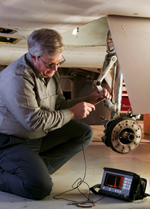
Overhauls are fairly involved and make use of a range of different nondestructive testing (NDT) technologies. First the wheels are removed, disassembled, cleaned, stripped of paint, and visually inspected for wear, cracks and corrosion. A caliper is used, for example, to measure small areas, such as the diameters of bolt holes, for dimensional wear. Then, depending on the type of wheel involved, various forms of NDT can be employed. Any repairs that can be made are done at this time, and then the parts are painted and reassembled, and new tires are mounted and leak-checked, after which the wheels are returned to service or released to the customer.

West Star uses any of three types of NDT methods in overhauls—eddy current, dye penetrant and mag (magnetic) particle. The choice of technology depends on the makeup of the wheel assembly and the requirements of the manufacturer’s component maintenance manual although the shop routinely conducts an eddy current examination of the wheel bead seat—the flat area of the wheel that the bead of the tire rests against—each time it changes the tires.

Eddy current can be used to detect cracks that are not visible to the eye, Goede says. But even if only a small crack is found in a wheel, the wheel is typically rejected, he says. Dye penetrant involves dipping a wheel in penetrant, processing it via a rinse bath, and air drying it in a circulating oven, after which a developer is applied. Then the wheel is examined under an ultraviolet light. This method is used to detect cracks and impurities. Mag particle is used for examining the bolts for cracks, impurities or other flaws. It involves magnetizing the bolt while examining it under ultraviolet light. Both the eddy current and mag particle procedures involve inducing a temporary magnetic field in the components under test.

Brakes: Steel, Carbon or Electric?
The entire industry is leaning towards carbon brakes, Honeywell executives assert. Lufthansa Technik also sees a trend towards carbon brakes, as the mean time between repairs (MTBR) for carbon brakes is 1,500-2,000 cycles, compared with some 1,100 cycles for steel brakes. Carbon brakes, especially Messier-Bugatti carbon brakes, have overtaken the industry, asserts David Kirby, vice president and general manager of Dallas Centerline, a Texas-based repair station.

Carbon brakes are popular where weight reduction is crucial, adds Steve Kelly, director of product repair services for Aviall, but steel brakes will continue to have a place because they are significantly lower in cost.

“One of the most intriguing new technologies is the ‘electric brake,’” where electric actuators operate the brake in lieu of hydraulics, Kelly says. This upcoming development will add weight savings, as well, Kirby notes. But the technology is still new in the commercial world. The 787 is the first airliner to fly electrically actuated brakes. Boeing boasts that this system, developed by Goodrich, reduces the complexity of the component and increases its dispatchability compared with hydraulic brake systems.

How One Company’s Detective Work Roots Out Counterfeit Electronic Parts

The proliferation of bogus electronic parts is relatively new, and the problem’s cause is unique compared to most other aircraft components. Fortunately, the aviation industry can turn to labs such as at Integra Technologies.
by David Jensen

Although counterfeit, or bogus, parts have long plagued the aviation industry, their existence in airborne electronic systems is relatively new—and unique. Counterfeit parts commonly emerge once the original part is no longer manufactured thus becoming obsolete. Driven by the mile-a-minute changes in the consumer electronics market, components such as integrated circuits (chips), connectors and resistors can become obsolete even before the airborne system that incorporates them is produced—indeed, even before the system is developed and certified. The U.S. Department of Defense refers to the parts obsolescence issue as DMSMS (diminishing manufacturing sources and material shortages).

Not surprisingly, when a system such as a radio, radar or display is fielded and needs support, the production of the original parts it encases likely is long past. Small orders, say, for fewer than 100 parts, often indicate a maintenance requirement.

When the primary sources of electronic components run dry, the original equipment manufacturers (OEMs) of avionics must seek other parts providers, either to continue producing their airborne systems or to support their systems or both. At the same time, they also must brace for the possible infestation of bogus parts.

One way to avoid bogus electronic components in the supply chain is to have them thoroughly examined and tested. To learn about the bogus electronic part problem, Aviation Maintenance traveled to Wichita, Kan., to visit Integra Technologies. Nestled inconspicuously among shopping plazas in the city’s bustling northeast quadrant, it is one of the world’s largest labs equipped to evaluate electronic components. Mark Marshall, vice president of engineering, tells us about the sources of bogus electronic parts and how his company detects their inauthenticity.


When Parts Run Out

The manufacturing cycles of most electronic parts are “driven by their use in commodity-based, consumer products,” says Marshall. He notes that the turnover of items such as laptops, computer tablets and smart phones has reached a fever-pitch pace compared to that of airborne systems, which must be tested extensively, certified and potentially used for many years. And while the industrial and automobile markets may be large enough to entice electrical parts manufacturers to lengthen their production runs on some components, the aviation industry is not, Marshall asserts. “For them, the aviation market is just too small.”

The only recourse for avionics OEMs is to stock up. An electronic component manufacturer commonly issues a product change notice (PCN), announcing when it will no longer produce a certain part. OEMs that incorporate the part in their systems usually then make last-time buys (LTBs), purchasing the part in large quantities.

So crucial is the need to stock up adequately that most manufacturers of critical electronic systems supplement their supply-chain management expertise with the forecast services of the Center for Advanced Life Cycle Engineering (CALCE), which exists within the University of Maryland’s Department of Mechanical Engineering. Among other offerings, CALCE has developed algorithms used to predict the date for an electronic part’s obsolescence.

However, with all input and calculations made, electronic systems manufacturers’ parts inventory still may fall short. “And sometimes overzealous [inventory] managers decide prematurely that they don’t want their inventory, and they get rid of it,” Marshall adds.

At this point, an avionics manufacturer must look to “secondary sources,” or parts brokers, for obsolete components. Generally, brokers buy up unused parts from the manufacturers, “probably for pennies on the dollar,” says Marshall. “They stock the inventory, hoping that someday somebody will need the components.”

In some cases, the broker does not stock parts but serves as an agent who can find sources for components. “Brokers can range from very sophisticated, very capable organizations to, literally, one person with a phone,” says Marshall.


Made in China

Determining the true source of an electronic part may be tricky, and counterfeit parts can inadvertently enter a supply chain. The primary sources of bogus parts are in China, where companies have found a lucrative business selling components meant to be destroyed. The illicit process works as follows.

In the past decade, many of the used-up computers, industrial electronics and consumer devices have been considered junk and sent to China for demolition to recover recyclable materials. According to Marshall, recycling electronics is a “messy process, involving hazardous materials,” that many western countries would rather avoid.
The Chinese companies will accept electronic junk, also called “e-waste,” but instead of presumed demolition, they strip off the electronic devices and attempt to resell components.

Although he admits it is difficult to say where bogus parts come from, Marshall claims that most suppliers “are almost all overseas [non-U.S.],” and he estimates that “80 percent, and perhaps more, of the parts come from China.” He bases this high estimate on the fact that most counterfeit parts sources have been traced back to that country. Chinese companies have “built an industry” around bogus electronic parts, he states.

A U.S. congressional study completed in 2012 confirms Marshall’s assessment of the counterfeit parts problem. According to the daily newspaper Wichita Eagle, the study reports that in 2009 and 2010, 1,800 cases of bogus parts were reported in the United States, totaling more than one million electronic components. It also claims more than 70 percent of the bogus parts came from China. Marshall says about five to 10 percent of the electrical components his company tests from broker sources are found to be counterfeit.

At first, according to Marshall, the illegitimacy of bogus parts was easy to detect. The counterfeiting entity initially “would simply sort out the parts by pin count and package, regardless of what was inside them, then sand the top of the part and remark it to look like something else,” he explains. “Even if you failed to detect them as counterfeit, as soon as you put the part on a [circuit] board, you knew it was wrong because it didn’t work.”

But the Integra vice president warns that counterfeiters have become much more sophisticated. “They’ve gone from parts sorting to numerous methods of counterfeiting,” he says. “More often, you will now get the right part or device function, but it may be used or have been modified.” The counterfeiters have also begun refurbishing used parts, cleaning and recoating them to look like new.

In fact, according to Marshall, electronic components can sometimes look too new. “It’s a red flag,” he says. Unused parts that have been in storage over time usually appear less than new. “Things oxidize,” he explains.

Paperwork accompanying an order for parts assures no protection against counterfeiting. “Original paperwork is usually lost anyway,” says Marshall. “And the counterfeiters can falsify paperwork, too.”

He says the obsolescence problem that bore counterfeiting “certainly has accelerated over the past 10 years.” He sees the problem worsening, though perhaps at a somewhat slower pace.

Lab Detective Work 

The counterfeit problem has prompted avionics OEMs to seek out the services of companies such as Integra Technologies. Although many electronics test labs exist worldwide, they remain rather exclusive to certain niche testing requirements. Marshall estimates there probably are “fewer than 50 labs in the U.S.” With 200 employees, Integra is one of the largest labs and among the select few that specializes in electronic parts.

A tour of Integra’s facilities reveals an environment as clean and orderly as a hospital operating room. Occupants must wear smocks made of conductive fibers to dissipate static electricity, which can damage components. The engineers and technicians also must wear wrist straps and shoe covers. For some tested product types, hairnets must be worn. Room temperature and humidity levels are scrupulously controlled.

Integra Technologies tests electronic components for various reasons. Most tests are for parts qualification and/or acceptability, testing for a certain application requirement. A tested part may be an application-specific integrated circuit, or an ASIC, which is custom made. For, say, aviation or military use, a part generally must be tested to operate in temperatures ranging from -55 to 125 degrees C.

The company employs temperature-forcing units to test parts in various physical environmental conditions. And, using automatic test equipment (ATE), Integra’s electrical engineers design conditions meant to simulate the operational environment in which a part must perform. Extreme conditions may be employed to accelerate the part’s life. Given that ATE such as the Teradyne J750 and Verigy/Advantest 93000 can cost up to a million dollars and more each, the company gets all possible use out of its equipment, performing tests on electronic parts 24 hours a day seven days a week.

Integra Technologies has some 400 customers, including all major avionics and aircraft equipment manufacturers. “The biggest drivers of the qualification work are space and military users,” says Marshall. “NASA and its subcontractors are the most exacting customers, often requiring extended testing flows that can entail many months of environmental stressing and analysis.”

For counterfeit parts detection, we saw Integra technicians viewing computer screens hooked to microscopes and X-ray machines. They work like detectives searching ever deeper for clues to determine authenticity.

An integrated circuit, for example, first will be examined under a low-magnification microscope to check its overall condition and for suspicious anomalies. From there, the part may go to a person using a high-magnification (1000X) microscope to see, for instance, if the identification inside the package matches the identification on its outside. To examine its internal construction, the integrated circuit may then be X-rayed. Commonly, a number of parts in a batch are X-rayed to assure consistency in their construction, according to Marshall.

Counterfeit detection is not all black and white. “There may be gray areas,” says Integra’s vice president. “If we’re not certain a part is counterfeit, we may say it is ‘suspect’.” Any uncertainty is counterbalanced by thoroughness. From its tests, Integra will submit to its customers copious reports—sometimes 50 pages with both copy and photographs—and initiate conference calls to go over the details of its testing. “Usually, we have fairly high confidence [that counterfeiting has or has not been detected],” says Marshall. “But occasionally, the evidence is just not overwhelming, so we end up on the side of caution.”

Bogus part detection represents a significant part of Integra Technologies’ business. Since the issue of obsolescence and parts counterfeiting is showing no signs of going away, the company expects continued growth in this area.

For the foreseeable future, the aviation industry will no doubt require the services Integra provides. “Even a company like Fokker, which hasn’t made aircraft in years, is still supporting their planes,” says Marshall. “And we are there to support them.”

[s2If is_user_logged_in()]
READ FULL STORY >>>
[/s2If]
[s2If is_user_not_logged_in()]
[message_box title=”To READ the full article in our digital edition you need to be a registered subscriber to the magazine – If you are NOT then goto the SUBSCRIBE section of the site first before you can login” color=”green”]

[/message_box]
[/s2If]

Keeping Up with Aviation Tools

Applicable aviation tools and their advances are a necessity
By Mark Robins

Hammers are one of the oldest human tools known to man. Stones attached to sticks with strips of leather or animal sinew were being used as hammers by about 30,000 BCE during the middle of the Paleolithic Stone Age. Many millennium later, in today’s aviation maintenance arena, dead blow hammers and plastic tip hammers are still being used — along with a plethora of many other aviation tools — by engineering professionals to service, repair, overhaul and maintain diverse aircraft.

Aviation maintenance tools include drills, drives, adapter sets, cable pull testers, box wrenches, socket sets, tie guns, crimpers, universal positioners, infrared thermometers, metal cutting fluids, blind riveters, tensioners and many others. Used by aircraft engineers to ensure an aircraft’s structural soundness, many specialized tools are available to check fixtures and perform repairs on structures, components and equipment. Some are so simple they can be found in a home toolbox; others are unique to aircraft maintenance.

Every aviation maintenance tool has a specific purpose and innovative companies are always looking for ways to advance its usefulness.

Advances, ergonomics, change

Clearly, the right tools in the hands of trained aircraft engineers will significantly reduce downtime and costs. While change is always constant, even in the aviation maintenance tool arena, a hammer’s main function in the Stone Age isn’t that different from its function in a hangar. So how and why are companies creating new advances in tools?

“Tools are the key to efficient and effective maintenance of jet engines,” says Tim Meyers, customer technical training leader, Evendale, Ohio. “Applying new technologies, as well as user input for improvement, are key for customer satisfaction. We are always looking to improve our customer experience with improved productivity and ease-of-use tooling. Working safety is always a key consideration with every design and consideration of new technology. Achieving these critical-to-quality parameters is important for our OEMs and our customers. Special ergonomic considerations are being made to ensure the fundamental designs are lighter and tools are easier to use, also ensuring improving safety and improving material handling methods.”

Utica, a division of Lexington, S.C.-based Apex Tool Group, understands ergonomics and the tool-and-engineer interface. It even found a way to add new features to its line of screwdrivers, a tool that was berthed in the 15th Century. Each of Utica’s three standard adjustable models is distinguished by red, blue and black for easy identification. A patented, spring-loaded locking collar locks the scale at the desired torque setting. This prevents the operator from accidentally using the
wrench in the unlocked position, which may lead to incorrectly tightened fasteners.

Conyers, Ga.-based Proto Industrial Tools has introduced a new line of full-polish chrome, reversible ratcheting combination wrenches with spline box ends. A new open-end configuration allows up to 13 degrees additional swing. The line includes 38 fractional and metric sizes as well as four wrench sets. “Spline ratcheting wrenches are commonly used in the aerospace industry and have been a key growth driver in recent years,” says Alan English, senior brand manager. “We are proud to be the first hand tool manufacturer to offer this configuration meeting stringent Berry Amendment regulations for Made in the USA products.” The new wrench pattern features a patented I-beam design that removes material weight while offering an increased bearing surface to help improve comfort and reduce hand fatigue.

Ryan Bendell, president of YARD STORE.com, Wichita Kansas agrees that ergonomics is a major push in aviation tool advances and is even willing to test them to prove it. “Newly designed tools make it easier and safer on the operator, and produce better quality work more consistently,” he says. “Every new or different tool we sell has been tested in the field. The Yard provides tools we are considering adding to our line to customers to test and report on the quality, usefulness and ergonomics.”

The marketplace is a driver of new advances in tools. “There is an overall requirement in life-cycle management to reduce costs to stay competitive in the market,” says Jerzy Komorowski, general manager of aerospace, National Research Council Canada, Ottawa, Ontario. “New advances in tools can deliver these cost savings.” Komorowski believes that since many aircraft are being used beyond their original design life, their maintenance may not be supported by the OEM, hence the push for tool advances. Also, he sees environment-related damage, such as corrosion and erosion in airframes and engines that trigger or induce maintenance to prompt new tool advances because these conditions “were not adequately considered in the OEM design and full-scale testing.”

Adoption and intelligence

While, Bendell admits certain aviation maintenance procedures and their tools remain unchanged claiming, “the basics of installing and removing rivets has not changed much in 50 years,” he is not wary of new tool advances when they are applicable. For example, “The Yard Store was early to adopt the Wichita State University study that Tungsten bucking bars reduced vibration on the operator,” he says. “Many thought that rivet buckers would not pay $250 for a bucking bar shape in Tungsten they used to pay $15.00 for. Once mechanics started using our Tungsten bars, it was the beginning of widespread adoption of these superior tools.”

Savannah, Ga.-based Gulfstream is a company that has realized these Tungsten bucking bars are a tool advance that has indeed helped reduce the risk of injury for employees, and help maximize work efficiency and quality. “A typical aircraft includes thousands of rivets, which are used to fasten the skin of the aircraft to the frame and attach many aircraft parts and additional structural components,” says Paul Dellinger, director of environmental health and safety at Gulfstream. “The employees who perform this skill are more susceptible to arm, hand and wrist injuries due to the repetitive motions they make with a hand tool such as a pneumatic riveting gun. These injuries or conditions, called work-related musculoskeletal disorders (WMSDs) include carpal tunnel syndrome and tendinitis.

“During a riveting task, a rivet punch or rivet gun punches a stroke on the rivet head. A bucking bar, which is held up against the other end of the rivet, then closes up the rivet. Years ago, the person holding the bucking bar was a lot more susceptible to WMSDs because the bar was typically made of steel, which did not dampen vibration well. Tungsten bucking bars are denser than steel, adding enough weight to dampen the vibration. The result is less stress on a person’s hands and/or arms, which means less fatigue and less chance of injury.”

Thierry Laffont, global account leader at GE Measurement & Control in Lyons, France, believes one driver behind advances in tools is the lack of qualified aircraft maintenance personnel. “The aviation maintenance industry, like many other industries, is suffering a gradual decline in the number of technically qualified inspection personnel in the sector,” he says. “This is caused by the retirement of many highly qualified inspectors. Consequently, it is important that inspection tools are increasingly smarter, allowing inspection tasks to be carried out by technicians who are not as well qualified. GE Measurement & Control is a technology-led company, which strives continuously to improve its offerings. These improvements can be in functionality and efficiency as well as ‘smartness.’”

To fully maximize the ergonomics and intelligence that new tool advances can offer, Gulfstream utilizes an in-house team of three ergonomists in its tool selection process. “An ergonomist looks for ways an employee can do his or her job with as much safety and comfort as possible,” Dellinger says. “When choosing tools, ergonomists identify tools that are not only effective in getting a task accomplished, but also those that are less likely to cause injury. These are tools that can be used effectively with less force, less repeated movement and less awkward positioning of the body. Improved safety and health often leads to a boost in work quality and productivity.”

Tools go high-tech

As aviation changes and advances, so must aviation tools. The introduction of composite materials was a revolutionary leap for aviation and with it came new tools, far more advanced than just a hammer and screwdriver. “The biggest change coming to our end of the tool business is the introduction of composite construction on airplanes,” Bendell says. “What started with the Beech Starship has evolved into the Boeing 787. It will be much different in 10 more years.”

Composite materials inspection is becoming increasingly important. To do so, new high-tech aviation tools are allowing aviation personnel to see the unseeable. “New tools are being developed such as the Bondtracer, which allows flightline and ramp crews to evaluate the severity of composite impact damage right at the gate, in accordance with the aircraft’s maintenance manuals,” says Laffont. “This prevents unnecessary grounding or flight delay, providing significant savings. Bondtracer is as easy to use as a common stud finder. It has a simple display with green indicating consistent skin thickness and red indicating an unanticipated thickness change. It is designed to be a useful tool for ramp personnel with no nondestructive testing training or certifications.”

Everett, Wash.-based Fluke Corp. has produced two particularly sophisticated tools that it believes represent a once-in-a-decade advancement. Both electrical and electronics aviation systems (radar, communication) must be inspected, but to do that requires test tools designed to operate at the same frequencies used on board the aircraft. “Regular test and measurement tools test at 50 or 60 Hz, since that is the electrical frequency found in commercial electrical installations,” says Hilton Hammond, ScopeMeter product manager at Fluke. “Because avionics systems are engineered to be lightweight, they use different materials, affecting even the function and frequency of their electrical and electronic systems. Electrical power inspections should occur at 400 Hz, while electronics should occur at 500 MHz. At the close of 2012, Fluke introduced a 500 MHz handheld oscilloscope and a 400 Hz power quality analyzer, to meet these requirements. While measurement at these frequencies had been attempted before, these tools represented a breakthrough in safety rating, grounding, ruggedness, and battery life for a field tool – especially important in the military.”

Learning more

To learn more about specific tool advances and their correct usage, refer to maintenance instruction manuals. Also, “The OEM tool and equipment manuals are a good source for the latest information,” says Tim Meyers, customer technical training leader, Evendale, Ohio. “Additionally, tooling distributors also have key technical knowledge on new technology and advances.” Detailed information about aviation tools is featured on company websites.

To disseminate information on tool advances, Snap-on Industrial has developed several new Advanced Technology Labs (ATL). These vehicles showcase Snap-on’s tools, equipment, capabilities, services and solutions for the aviation industry. “The ATLs tour the country, visiting MROs and airlines to give technicians the opportunity to see demonstrations on how Snap-on’s innovations and technologies are making the aviation industry more productive and efficient,” says Scott Steward, aviation support manager at Snap-on Industrial, Kenosha Wis. “Snap-on is constantly working with our customers within the aviation industry to identify their needs and tooling requirements.”
[s2If is_user_logged_in()]
READ FULL STORY >>>
[/s2If]
[s2If is_user_not_logged_in()]
[message_box title=”To READ the full article in our digital edition you need to be a registered subscriber to the magazine – If you are NOT then goto the SUBSCRIBE section of the site first before you can login” color=”green”]

[/message_box]
[/s2If]

Training: It’s Not Just for Classrooms Anymore

DECK:

Today’s online solutions not only provide training on demand, in many cases they also deliver information in ways that is more beneficial to the technician in the field.

For all of its obvious faults, the worldwide Interweb is proving to be a pretty useful tool, especially if you are involved with the operation and maintenance of aircraft and helicopters.

Instead of waiting weeks to get the latest inspection and maintenance updates from the factory, that critical information is literally available to you at the touch of a key. And while having access to all this virtual information is a wonderful tool in itself, the real value is that it enables a technician to find the precise information they need when they need it.

Say, for example, you wanted to give your technicians a refresher on the importance of proper tire inspection and maintenance to aircraft safety. You could just have them reread the information available in a technical manual (yawn!), or you could go to: http://www.faasafety.gov/gslac/ALC/CourseLanding.aspx?cID=269 and have them take an online refresher training course.

The key thing to remember, especially when dealing with younger technicians, is when it comes to information retention and value; successful online training is not so much based on what the information is, but rather how that information is delivered. And the delivery vehicle of choice today, and in the future, is online and on-demand.

“What we have seen is that the new-generation of aviation maintenance technicians we are training today have grown up differently than the technicians that were trained 10- or 20-years ago,” explained Josie Sutcliff, V.P. Marketing for (3D solutions training provider), NGRAIN (www.ngrain.com) “These new technician didn’t grow up in their garages turning wrenches, they were playing video games on computers.”

Too true. The way today’s ‘twenty-something’ technician learns is light years removed from the way we all learned in the “dark” (pre-Interweb and iPad) days. Their attention spans aren’t long if they’re not visually and informationally stimulated. And few things are less stimulating than hour upon hour of PowerPoint slides and diagrams on how a particular inspection is preformed.

“When we look at how traditional maintenance training has been done, it’s usually in several phases,” Ms. Sutcliff said. “Theoretical instruction in the classroom – chalk and talk, if you will – instructor lead instruction on concepts and theories. Then the student progresses on to the procedural steps where they get their hands-on training on how to do the mechanical task.”

“Our big picture vision is about transforming the way people share knowledge and where that applies at the aviation maintenance level is we are doing this by making it easier, faster and better for organizations to create interactive, 3D, virtual maintenance training solutions.” she said. “It’s really much more intuitive for the students.”

That was then. This is now…

What NGRAIN has done is to essentially provide a technology that allows theory and practice to be delivered simultaneously. “So the gap that used to exist between learning the theory and putting that theory into practice is now removed,” Ms. Sutcliff said. “For example, they can do a system orientation using 3D models, parts overviews, fluid and flow training – that sort of thing. The students will actually see how it all works together.”

Just try doing that effectively with PowerPoint slides.

“Using our 3D capabilities, we are adapting today’s training to meet the needs of these types of learners,” she said. “Our’s is a more technology-based solution that allows knowledge to be communicated in a more visual and interactive way.”

Ms. Sutcliff explained that research has shown that if you read something you are going to understand it at one level. If you watch someone do it you will understand and retain the information at a higher degree. But, if you are able to do it yourself you will learn how it is done in a faster and more thorough way.

“Using an NGRAIN solution, a technician can actually, virtually interact with the 3D model of the aircraft,” Ms. Sutcliff stated. “They can actually perform many procedures in real-time right on the 3D model. The total effect is a more intuitive and immersive learning experience than the traditional training model.”

Ms. Sutcliff also shared that in addition to being able to see and do the actual work – virtually, of course – the system will automatically give the student feedback on what they are doing correctly and incorrectly. There is no one to judge your abilities or lack thereof.

And as we all know from first hand experience, there’s nothing more demeaning than having to stop the instructor – again – to ask for them to go back over a point that you just aren’t getting. With the 3D simulations, students can go back and try it again until they are comfortable to move on. No one is looking over his or her shoulder.

Ms. Sutcliff stressed that the ability to repeat a lesson at the user’s convenience is a critical element in improving the effectiveness of any online training program. According to NGRAIN studies whether integrated into Interactive Electronic Technical Manuals (IETMs), Distributed Learning courseware to supplement standard work cards or as tools to provide maintenance task reviews, the company’s 3D-based software and solutions are proven to improve first-time fix rates by upwards of 25 percent.

Right time training at real-world costs.

As the world’s business and commercial aircraft continues to grow and spread into new regions, so does the need for aircraft airframe and engine manufacturers to provide up-to-date training to technicians who may be literally on the other side of the world.

“It [online training] minimizes the impact on revenue generating tasks,” stated Michele Asmar, director, Learning Innovation and Solutions Design, CAE (www.cae.com). “Training can be done at convenient times for the student and impacts less on their work schedule. No travel is required, which reduces costs as the online model is accessible anywhere in the world and therefore it becomes much less time consuming.”

“Large and small MROs are increasingly suffering from shortages of experienced technicians and attending a class on or close by their facility offers them more scheduling flexibility – less downtime for travel – in addition to major travel and lodging cost savings,” she added. “This opens the door to an increased use of E-learning and distance learning in the near future.”

“People are less and less able to be in one location for training so being able to provide quality training anytime while leveraging the new mobile devices is a growing trend,” Ms. Sutcliff said. “It’s a capability we don’t see a clear end to. The industry is trying all kinds of options now.”

One operator in particular that Ms. Sutcliff highlighted who is taking advantage of the online training model is the U.S. Army’s helicopter operations at Fort Rucker. “They have been using NGRAIN for many years now. In particular, they use our 3D Knowledge Object – our interactive 3D format that lets them produce animations to integrate into their courseware,” she said. “They have achieved a really impressive ROI compared to the way they did specific training in the past.”

Ms. Sutcliff said that the team had been relying on a limited number of hardware-based panel trainers. The units were very expensive to maintain and were becoming prone to breakdowns, which caused repeated scheduling problems especially when technicians had to travel to the training facility.

“That was the reason they decided to try the interactive 3D training solution,” she said. “They were able to make the training available online and on-demand. They haven’t looked back.”

Online training’s ever broadening appeal.

Of course the benefits of online training programs extend well beyond the scope of maintenance training. Pretty much anything that requires a classroom can be supplemented, if not outright replaced by a well-produced online solution.

And for aviation technicians working in this rapidly expanding global industry, the benefits on online training are extending into the necessary “soft skills” as well.

For example, the International Air Transport Association (IATA) recently announced that it has entered into an agreement with Rosetta Stone (www.rosettastone.com), providers of technology-based language learning solutions to provide second language training to IATA member airline employees.

According to a recent release, the program will be based on Rosetta Stone’s TOTALe PRO solution, which combines mobile applications with live online tutoring and group-based interactive learning games encompassing over 20 languages.

“If ever there was a truly global industry, aviation is it,” stated Judy Verses, president, Global Institutions at Rosetta Stone stated in the release. “Being able to communicate across boarders and cultures is a vital skill for global organizations, and we’re delighted that IATA – which represents airlines all over the world—has chosen Rosetta Stone as its go-to language-learning solution.”

In the same announcement release, Ismail Albaidhani, Head of Global Partnership & Learning Innovation and interim head of ITDI stated, “Airlines and supply companies serving the global aviation industry may operate in dozens of different countries. Language and communications skills are critical. This partnership with Rosetta Stone will enable us to better serve the education and training needs of the industry.”

Speaking of the added value of online training to non-English speaking technicians, Ms. Asmar pointed out that CAE is seeing a trend for maintenance trainees in emergent countries to spend more time studying a particular aircraft’s systems online before traveling to attend a type-specific maintenance course.

“More particularly [our] Chinese clients, who also have an additional challenge with their level of understanding in English make sure they are better prepared before attending the class,” she said. “More E-learning as part of their pre-study material is very beneficial.”

Ms. Asmar also stated that along with using the online tools to prep for type school, CAE is seeing significant growth in general refresher topics like batteries, hazardous material handling and other non-aircraft specific training. “Aircraft walk arounds and virtual tours are also ideal for our E-learning,” she said.

As you may expect, while the attraction of online learning is universal, the technology not without its challenges. “Regulatory restraints remain the biggest roadblock, especially in Europe where online delivery of specific type training is not authorize under EASA rules,” Ms. Asmar said. “However, Swiss, Austrian and German EASA authorities have provided guidance to the Part-147 A/C Maintenance Training Organizations that up to 30-percent of an AC Type course can be done through e-learning.”

As for the FAA’s stand on online/E-learning they are “looking into it.” “We are addressing recommendations from the Part-147 Aviation Rulemaking Advisory Committee that addresses distance learning,” an FAA spokesperson said.

The future is online…

So whether you need to brush up on the latest procedures for troubleshooting a bulky braking system or want to learn conversational Arabic to land your dream MRO job in Dubai, you are probably going to spend most of your educational time with a laptop or iPad.

“Just-in-time training will become increasingly popular for operations,” Ms. Asmar stated. “Training provided during [actual] operations is much more effective, leading to immediate application of the learning, faster learning and a higher mastery, and finally, faster resolution of problems on the line.”

“There has been a lot of buy-in and a lot of proof that you can meet, if not exceed, the training requirements using an interactive 3D solution versus the ‘cold hands, warm feel’ type of training,” Ms. Sutcliff said. “It’s the growing trend and one we don’t see an end to any time soon.
[s2If is_user_logged_in()]
READ FULL STORY >>>
[/s2If]
[s2If is_user_not_logged_in()]
[message_box title=”To READ the full article in our digital edition you need to be a registered subscriber to the magazine – If you are NOT then goto the SUBSCRIBE section of the site first before you can login” color=”green”]

[/message_box]
[/s2If]

Maintenance Software: A World of Choice

The days of relying on paper, pencil and memory to monitor the status of mechanics, jobs and materials—and steer maintenance projects toward completion—may be numbered. Ordering parts, tracking progress on different tasks and recording hours worked is complex enough. But dealing with the inevitable delays, glitches and bottlenecks while keeping a steady hand at the tiller is a different matter.

These challenges have spurred more and more organizations to adopt software solutions that help them manage the process–planning work, buying parts and scheduling labor while getting aircraft back to the customers on time.

There are around 100 maintenance and engineering (M&E) software systems available on the market. At least one is based on a well-known enterprise resource planning (ERP) system. Others were designed for maintenance from the start although they may include ERP functions like financials and human resources. And some fit a specific niche in the maintenance ecosystem like automated electronic commerce or publishing. There is software for customers of every size, from small repair stations all the way up to major MROs.

In addition maintenance software solutions are starting to offer cloud-based access, personalization to roles or individuals, access via mobile devices, and connectivity to aircraft before they reach the gate.

Maintenance ERP

British Airways Engineering’s SWIFT MRO is based on SAP’s ERP system. The organization is now partnering with Tata Consulting Services (TCS), its support provider, to market the system to airlines/MROs worldwide. They landed a Far Eastern flag carrier last year and have other prospects in the pipeline. “Most large legacy carriers in our target market have not made the transition from old mainframes to modern, scalable, robust, supportable platforms,” says Rajan Bindra, British Airways Engineering’s commercial sales manager.

The MRO counts among its strong points that its sales team includes both maintenance experts and IT experts. Prospects can come to London, see the system in use and question the users without restriction. Airlines can host the system on their own servers or have TCS host it for them. The latter route becomes a cloud-based, software-as-a-service offering.

British Airways Engineering also has developed a mobile solution for line maintenance via iPhones and iPads. The MRO planned to ramp up from 15 to about 100 users by the end of April 2013. The PC-based solution already had been tailored to job functions, so that individuals see transactions relevant to them, but mobile access takes personalization a step further, Bindra says. “When you log into the application, it knows who you are and brings up tasks and jobs that are specific to you.”

British Airways Engineering also is working on real-time maintenance data feeds from aircraft to the ground. The MRO wants to have this application in place when new 787s and A380s start arriving this year. Data is transmitted from the flight deck electronic tech log—part of the electronic flight bag—to the ground, so that maintainers can get up to 16 hours’ notice. The MRO is fine-tuning this capability, using two 777-200s retrofitted with electronic tech logs provided by Ultramain Systems, and the interface has been live since April 2012.

Hybrids

Other products are built specifically for the maintenance market but include traditional ERP modules like financials and human resources. These hybrid solutions try to offer the best of both worlds to customers who may not already have an out-of-the-box ERP system.

Ramco’s Aviation Suite includes back office functions such as finance and HR, as well as deep maintenance and engineering functionality, says Thamizha Nambi, the company’s senior vice president for aviation solutions. The software also can integrate with Oracle or SAP, if a customer already is using those ERP systems.

Ramco’s latest release, version 5.6, adds a feature called WorkSpaces, which tailors the software experience to specific roles in the organization. This specialization, or personalization, feature allows managers, when they log in, to see everything they need to know, such as transactions pending approval and exceptions in a visual way. Role- and functional-area WorkSpaces include tech records, stores, procurement, receiving, sales, accounts payable and accounts receivable. Ramco has a wide customer base among regional airlines and helicopter operators.

Ramco’s solution is accessible via a customer’s own network but also via the public cloud, using Web giant Amazon’s server services. Among the benefits are flexibility and long-term savings, as customers offload the costs of buying and maintaining hardware and software. Security is not really an issue because each customer’s data is stored in a separate database, Nambi says. The software already is tuned to leverage the capabilities of mobile devices such as iPads and iPhones.

Nambi notes other emerging trends. People want to be able to perform searches on application data—to find, for example, what transactions are open for a particular component, he says. They want to be able to mine their data. In response, Ramco is rolling out an enterprise search function with release 5.6.

Personalization also is becoming more of a trend, as software migrates to mobile devices, Nambi observes. The user naturally wants to see only what is relevant to his job. The next step in personalization is for the software to use location information that is available from an iPhone, he says, to reduce the volume of data the user is required to enter. This could be integrated with a part or tool request, for example. Ramco expects to integrate location intelligence into maintenance transactions in the next version of the software, he says.

Pentagon 2000SQL

Pentagon 2000 Software’s Pentagon 2000SQL is an ERP because “it supports all of an enterprise’s general business…activities—including accounting and financial reporting,”as well as industry-specific maintenance functions, according to the company.

Its “core” modules, however, include functions such as inventory, quotations, vendor RFQ-purchasing, shipping and invoicing, electronic catalog, and virtual warehouse management. Among the system’s strengths are its complex materials management capability, says Kirk Baugher, executive vice president of business development. Typical MRO software systems are not strong in this area, he says.

Among its customers are Fokker Services, HEICO, Airbus Military North America, L-3, Elliott Aviation and “lots of repair stations,” Baugher says. More than 80 percent of its customers are in the aerospace industry. Pentagon 2000SQL also offers out-of-the-box links to Aeroxchange and Aviall.

The software, which uses Microsoft SQL Server database, takes about 30 minutes to install, Baugher says. Implementation, including data conversion, takes weeks to months. The company partners with Rackspace to provide cloud-based access, but most customers host the software on their own server networks. The software also can be run on an iPad over WiFi, he adds. Bombardier/Flexjet uses the system for heavy maintenance, employing battery-powered laptops on roller carts, Baugher says. The software is commercial off-the-shelf, or COTS, but is flexible enough to allow users to customize forms and set different behaviors.

Mainstream Solutions

In the middle of spectrum are mainstream solutions that focus on a wide range of maintenance functions. Among these are AMOS, EmpowerMX and Commsoft’s OASES.

AMOS

Swiss AviationSoftware emphasizes that its AMOS solution is not an ERP but a “best-of-breed,” maintenance-specific application. Although the product has “HR” and “finance” modules, these are intended for MRO usage only and cannot replace the similar-sounding HR and finance modules of an ERP system, the company explains. The HR module in AMOS, for example, covers maintenance functions like shift planning, resource management, and capacity planning but does not offer pay check management. AMOS, however, does interface to ERP systems.

Key AMOS modules include material management, engineering, planning, production, maintenance control, component maintenance and quality control. Users can access the software through their own networks or over the Web.

AMOS is scalable from 10 to several hundred concurrent users or from one to several hundred aircraft, according to Ronald Schaeuffele, the company’s CEO. The solution is flexible enough to accommodate the needs of 110 diverse customers worldwide, including major low-cost, regional and flag carriers, large airline groups and MRO providers.

EmpowerMX

EmpowerMX also is a mainstream application. The company stresses that its software is not a “point system,” but can serve every facet of maintenance, including areas such as invoicing and resource management. It offers solutions for three aviation verticals: FleetCycle Aero for airlines, FleetCycle MRO for third-party MROs and FleetCycle TS (technical services) for process outsourcing.

EmpowerMX recently signed Delta TechOps to a long-term subscription agreement, using the software company’s cloud-based FleetCycle MRO Manager product as its “primary maintenance execution tool in all of its airframe MRO facilities.” Other EmpowerMX customers include Southwest, Frontier Airlines and U.S. Airways.

The MRO Manager product also provides management dashboards that give at-a-glance visibility into key metrics for “instantaneous decision making,” according to the company. Managers can view displays showing, for example, estimated vs. actual hours, estimated vs. actual cost, and critical path items.

OASES

Commsoft clearly distinguishes its product from ERPs. While ERP systems may provide managers with control and visibility into their business processes, they tend to be less than optimal for maintainers, says Nick Godwin, managing director of Commsoft, the developer of the OASES, the Open Aviation Strategic Engineering System M&E tool suite. In addition, true ERP systems “cost a fortune and nearly always require a middleware system to adapt them to the maintenance environment,” he says. He considers OASES to be in the middle of the spectrum.

Commsoft also targets customers in the mid-range—airlines with up to 50 aircraft—as well as third-party MROs and commercial airworthiness management organizations (CAMOs) that manage the overall maintenance for groups of airlines or corporate fleets. OASES uses the Oracle database and Linux operating system. Commsoft has a considerable customer base in Eastern Europe and Russia. One CAMO in Russia manages maintenance for five airlines flying 737s, 757s and A320s. Another CAMO customer in Scotland controls 32 corporate aircraft.

Commsoft offers a hosted version of the product, but 90 percent of its customers prefer to buy their own servers and host the software on their own networks in their own IT environments, Godwin says. In fact, the German authorities are refusing to let operators access M&E systems via the cloud or hosted environments, he says. Performance, at any rate, is almost always better with standalone systems, he says.

Manual or electronic input of information from Excel or other sources required at the outset, but once the database has been populated, one person can manage 50 to 60 vendors, for example, according to Godwin. The full system can be implemented in 10 weeks, which is a relatively rapid turnaround, he says.

Project Management

Some software tracks maintenance and other software prioritizes and tells people what to do, says Sridhar Chandrasekaran, vice president for strategic services with Realization. The latter is Realization’s Concerto, he says.

“We have a system and method specifically designed for a highly variable operation like MRO,” he says. You can make all the schedules you want, but something will go wrong, Chandrasekaran says. “When all these things change in execution, we still provide a good priority system. That is a failure of traditional MRO software.”

Realization’s value proposition is that its software can reduce turnaround time by around 20 to 50 percent and increase productivity along the same lines, he says. Based on critical chain methodology, Concerto tells you when and how much work to release and—based on buffer management calculations—informs you where your priorities ought to be.

The software also produces reports, describing items such as performance across all aircraft, location of bottlenecks and what people should be working on. Concerto is a Web-based system, and the majority of users interact with the software that way.

The software is versatile enough to fit the needs of software development projects, as well, Chandrasekaran says. A recent customer is the Software Maintenance Group at the Warner Robins Air Logistics Complex. The Group, which provides avionics test software, had work in progress (WIP) in the form of a backlog of software programs. The real issue was to make sure that the engineers were working on the right task. Concerto helped them significantly reduce software development cycle time, he says.

EDI Niche

When it comes to shopping for parts, repair vendors or equipment loans to cope with AOG situations, Aeroxchange is a key player. Owned by a group of airlines, the company provides software for high-speed, automated business-to-business transactions.

“I have built an electronic community of suppliers and electronically orchestrate the ordering stream,” explains Al Koszanek, Aeroxchange president and CEO. The community includes more than 2,000 suppliers for purchasing and some 1,500 repair vendors.

The software is “very complementary to the maintenance packages, in that I bolt on to the supply chain function and provide a very high-end EDI [electronic data interchange] service to the client.” The company also provides bridges between its software and maintenance programs such as AMOS and Ramco, as well as to most ERP systems.

Aeroxchange offers a family of EDI products, such as AeroBuy for parts collaboration, AeroRepair, AeroComponent for electronic pool management, and AeroAOG for inter-airline loans. AeroAOG, for example, gives participants instant visibility into inventory running into millions of parts at some 750 different line stations worldwide. The system also provides reporting functions, such as status of orders relative to shipment and on-time delivery performance for suppliers. Customers include the likes of UPS, FedEx, Lufthansa Technik and Jet Blue.

Publishing

Enigma Information Retrieval Systems’ InService MRO specializes in the publishing and delivery of maintenance documentation. It includes publisher, revision management, viewing and job card generation modules. MROs can use it to aggregate internal and OEM content into a “one-stop library,” the company says. Among Enigma’s customers are Air France – KLM, FedEx Express, Korean Air, American Eagle, Rolls-Royce and Goodrich Aerostructures.

Enigma says its product stands out from comparable software in that handles content—whether SGML, XML, S1000D or PDF—in one, unified repository and allows a single interface for all airline content.

Enigma also integrates with maintenance and planning systems. It is the only vendor that has integration agreements with both SAP iMRO and Oracle cMRO solutions, according to the company.

AvPro Sidebar

Decision Software Systems’ AvPro software, based on the FoxPro database, is used it to track aspects of maintenance work such as project schedules, employee hours and part numbers.


Customers can pick and choose between modules dealing with inventory management, asset management, work orders, component maintenance, accounting and employee training. Small to medium-sized organizations are the best fit, says Nathan Schnurman, business development manager.


AJW Technique Jumps Into Component Repair Biz in Montréal

The official opening of the AJW Technique Component Repair & Overhaul facility occurred April 4, 2013, just six months after purchasing the assets of Aveos Fleet Performance in September 2012. The facility had extensive repair capabilities with best-in-class equipment but the infrastructure, certifications and workforce needed to be started from scratch. AJW Technique was able to achieve certification from Transport Canada (TCCA), FAA and EASA as an approved maintenance repair facility in those six months and has begun to fulfill repair contracts.

“AJW Technique primarily provides a broad range of Airbus and Boeing commercial aircraft repair and overhaul services, although we will soon be including helicopters, military, regional and business jets within the range of capabilities,” Christopher Whiteside, president of AJW Group, commented at a special ceremony attended by senior ministers from the Québec Government. “AJW Technique is actively working with new customers within the region to develop mutually beneficial support agreements. It is the centralized hub for the AJW repair supply chain and will ensure that the A J Walter Aviation customer base of more than 800 airlines receives exemplary support.” The opening of the160,000 square feet facility in Montréal has been underpinned by Government support and investment.

As the facility ramps up its technical capabilities in tandem with the streamlining of all processes, the company says it expects to reach its repair potential of around 25,000 units per annum in record time. The company believes their unique access to extensive Airbus and Boeing inventories is a key differentiator that will enable the business to underwrite its repair management guarantees.

“AJW Technique is not just a repair management provider. As part of the AJW Group it works alongside A J Walter Aviation, AJW Capital Partners and AJW Leasing to deliver a comprehensive range of aircraft support services,” explains Whiteside. “We work closely with the OEMs and other specialist repair shops on a global scale to support our power-by-the-hour, pooling, sales, exchanges and loans business. We’re a safe pair of hands with over 80 years in the industry and we invite all operators to talk to us about how we can improve their repair management cycles.”

AJW companies are based out of London, Singapore, Dubai, Miami and Montréal with strategic spares stock held at these locations; across the UK, Europe and North America. AJW provides sales and service support from a network of offices globally; conducting business in 115 countries.

In an exclusive interview at the grand opening, Whiteside was pragmatic and confident in his team, union-management relationships and their all or nothing approach. “We are a half a billion dollar business,” he said. “Had we gone out and bought or started a mum and pop shop even half the size…it doesn’t give the scale or the profile that A J Walter currently is expected to do.” He says he believed that to enter the component repair business they needed something proportionate to the size of their business. “Now admittedly this is over the top,” he said. “But the compensation for over the top is, you’ve got everything and therefore when you walk in to see somebody, all of a sudden, you can do 70-80 percent of their demand at day one rather than saying actually I can only do 5 or 10 percent and it’s an uphill battle.”

Whiteside went on, “Technique is challenged to bid for that business but like all companies they’ve got to prove they can do it well and they’ve got to prove they can do it quickly and they’ve got to prove they can do it within certain economic confines.” When asked what the biggest challenge from this point forward is Whiteside said, “Nothing keeps me awake in the sense of feeling I’m never going to get it done.” But he went on to add that their immediate concern is, “getting all the sales open and that is not until the end of June. The fact that it’s all cash out and no cash in [at this point].” Whiteside said that he expects the breakeven point to come by the end of next year.

Union issues flared up at that facility when it was AVEOS. Asked about the union now and how he feels about having to work with one Whiteside had this to say, “We have a good relationship with the union. There’s a thousand stories running around about this place maybe some are true. When I bought AJ Walter in 1994 twelve people came with the company and those people are still with me apart from my secretary who was my father’s secretary who retired and my chief inspector who died and even I can’t do anything about that. So those ten people have obviously been very happy to work for me for the past 20 years and therefore as a sociable, responsible employer, what do I have to fear from reasonable people on the other side?”

He said they don’t anticipate any workforce problems going forward. “We’re honorable. [Years ago] I said to my father, ‘Why have we been in business such a long time and why are we so successful,’ and he said ‘Because we do what we say we are going to do and we pay our bills.’ I said ‘How can it be that simple?’  and he said, ‘It is that simple.’ If you are like that with your employees it’s the same,” Whiteside said. One of the things he is most proud of in his career Whiteside said, “is attracting a bunch of talented people who could go and work for Boeing or Honeywell or British Aerospace or British Airways. We have a very strong culture at AJ Walter.”

When asked what the lessons learned since acquiring the assets, getting the certifications in place in such as short time frame and opening for business are, Whiteside said relationships are key as are in-person meetings. He said he learned that government can actually help when it comes to supporting and contributing to tax breaks, soft loans, grants and the like. Another piece of advice he offered, “Work in a courteous way with the authorities.” And finally, “Don’t dither. If you decide to do something, get on and do it. Do it quickly,” Whiteside said.
[s2If is_user_logged_in()]
READ FULL STORY >>>
[/s2If]
[s2If is_user_not_logged_in()]
[message_box title=”To READ the full article in our digital edition you need to be a registered subscriber to the magazine – If you are NOT then goto the SUBSCRIBE section of the site first before you can login” color=”green”]

[/message_box]
[/s2If]

State of the Industry vs. Forecast

Joy Finnegan - Editor in Chief
Joy Finnegan – Editor in Chief

The FAA released its annual forecast for the aviation industry in March. This report takes a look back at the previous year (2012) and then makes some predictions for the long range. I find predictions something to be leery of and that is one reason we don’t ask our “State of the Industry” responders to peer into the crystal ball (see story starting on page 22). We only ask about the current state of our business and what trends these leaders are seeing. I find this much more concrete and from these responses, readers can make their own judgements.

The FAA Forecast begins in this way, “Developing forecasts of aviation demand and activity levels continues to be challenging as the aviation industry evolves and prior relationships change. In times of amplified volatility, the process is filled with uncertainty, particularly in the short-term.” And adds, “The intent of these forecasts is to accurately predict future demand; however, due to the large uncertainty of the operating environment, the variance around the forecasts is wider than it was in prior years.”

But the FAA’s Annual Forecast has some interesting insights.

In a first this year, the FAA has changed its model for the U.S. domestic market from a GDP-based model to a model based on real disposable personal income (DPI). They say they have done this because they believe that aviation demand depends on the level of business and leisure activity in the economy. In addition, the report says “any changes in future tax policy that impact individual taxes will be more directly reflected in changes to DPI as opposed to GDP.” Taking this into consideration, the FAA now says disposable income, rather than GDP, is a better metric to use for forecasting future demand.

Some key insights from the forecast are a predicted modest pace of economic recovery with inflation remaining in check. The forecast period is 2013-2033. The FAA’s baseline forecast assumes that the economy recovers from the current downturn and suffers “no major mishaps such as large oil price shocks, swings in macroeconomic policy, or financial meltdowns.”

As we have been seeing for the last several years, the Asia/Pacific and Latin America/Caribbean regions will continue to have the highest growth rates. China is projected to become the world’s second largest economy by 2013 (surpassing Japan). And India is projected to see its GDP quadruple in size, growing at an average rate of 6.9 percent a year during the forecast period.

The forecast says commercial aviation system capacity is projected to decline slightly in 2013 and that load factors are projected to grow slightly during the early years of the forecast period and then growth will slow during the mid to latter years.

The U.S. commercial airline fleet has contracted by 713 aircraft since 2007. The forecast says the number of commercial aircraft will grow from 7,024 in 2012 to 8,554 in 2033 and after 2013, the mainline air carrier passenger fleet increases an average of 58 aircraft a year over the remaining years of the forecast period, totaling 4,907 aircraft in 2033. The narrow-body fleet (including E-190’s at JetBlue and U.S. Airways) is projected to grow by 28 aircraft annually over the period 2012-2033; the wide-body fleet grows by 26 aircraft a year as the Boeing 787 and Airbus A350’s enter the fleet. After 2013, the regional carrier fleet is expected to increase by an average of 5 aircraft (0.2 percent) a year over the remaining years of the forecast period, totaling 2,436.

According to the FAA turboprop/piston aircraft are expected to account for only 14.5 percent of the regional carrier passenger fleet in 2033, down from a 31.5 percent share in 2012. The report says the business jet market calls for strong growth in the long term, driven by higher corporate profits and the growth of worldwide GDP.

A particularly fascinating section of the report addressed unmanned aircraft systems (UAS) and says they are currently the most dynamic growth sector within the aviation industry. The FAA forecasts the largest growth in civil and commercial unmanned operations will be in the area of small unmanned aircraft systems (sUAS).

And of course it concludes with this statement, “Uncertainty exists in all industries, but especially in the commercial air travel industry.”

Forecasts frustrate me. I’ve read my fair share of them over the years only to see later how very wrong they were. So when there is a new one, I read it with a grain of salt. Anything can happen and we have seen some of the most unbelievable things happen in the last 10-15 years to include aircraft being highjacked and flown into skyscrapers, wildly fluctuating oil prices, natural disasters such as hurricanes, tsunamis and volcanic eruptions, public humiliation of those who use aircraft as legitimate business tools and so much more that influences how much we fly.

Who can predict what will happen next? The truth is, no one can. The next big influence on the usage of commercial, business or general aviation aircraft will be something no one has thought to include in a forecast because it is simply stranger than fiction.

Having said that, I guess we have to try to understand, to the best of our human abilities, where the industry is headed. In this way, we can attempt to plan and set goals for our businesses.

In that endeavor, I wish you the best of luck. You can find the complete FAA Forecast at www.faa.gov.
[s2If is_user_logged_in()]
READ FULL STORY >>>
[/s2If]
[s2If is_user_not_logged_in()]
[message_box title=”To READ the full article in our digital edition you need to be a registered subscriber to the magazine – If you are NOT then goto the SUBSCRIBE section of the site first before you can login” color=”green”]

[/message_box]
[/s2If]

Lufthansa Technik Reports Significantly Improved Result Even with Stagnating Revenues

lufthansa1Lufthansa Technik Group was able to increase its result in 2012 in spite of a decline in revenues to 4.01 billion euros as announced at their annual press meeting in Hamburg on March 19, 2013. The annual report of the 23 consolidated Lufthansa Technik Group companies showed an operating result of 318 million euros.

“Considering the strained situation of many airlines, especially in Europe, the overcapacity in the maintenance, repair and overhaul (MRO) market and heavy pressure on price levels, Lufthansa Technik Group has developed very positively,” said August Wilhelm Henningsen, Chairman of the Executive Board of Lufthansa Technik. Highlights of the year included the successful entry into service of the Boeing 747-8 at Lufthansa and the start of technical services for the Boeing 787.

“We were able to achieve this good result because many of our cost reduction measures are taking effect and we have been able to reduce the work required in many processes. In addition, a large number of new contracts contributed to our result in 2012,” explained Henningsen. Further measures to reduce costs and increase revenues have been introduced as part of the Lufthansa Group program SCORE, including restructuring programs in their larger production areas as well as targeted sales activities and administration efficiencies.

“We have already implemented many innovations in production and optimized processes there, and we are now striving for similar improvements in administration.” This area of Lufthansa Technik was analyzed by more than 200 experts from across the company with the objective of greater efficiency in all functions that are not directly productive. LHT says the reorganization of its structure and processes will result in the elimination of up to 650 jobs by 2015. Approximately 400 of those jobs will be eliminated in Hamburg. “The measures we have taken as part of the SCORE program have already had a positive influence on the fiscal year 2012 result,” said Dr. Peter Jansen, Chief Executive Finance of Lufthansa Technik. “However, we are dealing with rising personnel and material expenses as well as high price and cost pressures in the maintenance, repair and overhaul (MRO) market. Our business risks also include an economic situation in Europe that continues to be difficult, and overcapacity in the MRO market. But with this good result, we have created a financial foundation for the further restructuring and growth of the Lufthansa Technik Group, with the foremost objective of continuing to improve our competitiveness.”

The development of the international Lufthansa Technik network in 2012 was marked by both portfolio streamlining and capacity expansions. LTQ Engineering in Melbourne, Australia was closed and Lufthansa Technik Switzerland in Basel will discontinue operations in April due to reduced demand for line maintenance services. In contrast, Lufthansa Technik Philippines is now offering comprehensive A380 services in its new widebody hangar in Manila and Lufthansa Technik Sofia has doubled its capacity to five overhaul lines through a new complex of hangars.

lufthansa2Currently Lufthansa Technik has more than 730 customers and encompassing 2,200 aircraft around the world. In 2012 the company says it won 45 new customers and concluded more than 500 new contracts. The total sales volume in 2012 from those contracts alone amounted to 480 million euros Jansen said at the event.   Lufthansa Technik enjoys a solid market position, according to Henningsen. “We will continue our course for growth, and set ourselves apart in the market through our quality, the strength of our innovations and our worldwide presence. And this market position will be solidified and expanded even more through the successful implementation of the SCORE measures. That is why Lufthansa Technik will emerge from the consolidation in the airline and MRO markets even stronger than it is today.”

New Joint Venture Announced
Also announced at the event in Hamburg on March 19 is a joint venture with McKinsey & Company. Lufthansa Technik will now offer consulting services for the optimization of complex processes and the operative implementation of transformation programs within the framework of a new association with the consulting firm McKinsey & Company.

The joint venture will be headquartered in Hamburg and is scheduled to begin its work during the first half of 2013 and will offer consultancy in the efficient design of complex processes in the maintenance and repair of aircraft for international customers in the airline industry and other sectors. Lufthansa Technik says it feels they can springboard their work in successfully structuring processes in its own global network for maximum streamlining and efficiency, particularly through lean management projects to help others both in and outside of the aviation industry. The company says it has long supported several of its customers in improving their own production and service processes and is ready to parlay this knowledge to help others.

New Construction in Hamburg
Additionally Lufthansa Technik announced that starting in February it began building work costing 20 million euros in the eastern section of the technical base to develop workshops, offices and facilities for the Central Materials Technology department. As a result, this high-tech area of the company will be concentrated in a single location. Construction work is expected to be completed in the spring of 2014.

The new six-story complex will provide 6,000 square meters of workshop floor space on two levels, with the Central Materials Technology department on the second floor. The four floors above this, totaling 8,000 square meters of gross floor space, will be used for offices. The building will benefit from efficient insulation and the use of rainwater and parts of it will have a green roof. “With this new building, rather than going for expensive renovation work and retaining inefficient structures, we are investing on a sustainable basis and financing our future,” said Ralf Aljes, head of Facility Management at Lufthansa Technik. The building will use the existing plot ten times more intensively than the one- to two-story old buildings, which have already been demolished.


Airframers Push the Envelope in Aftermarket Support

BoeingShanghai3When we hear that original equipment manufacturers (OEMs) are expanding in the aftermarket, we typically think of the engine makers, with their large share, or the component OEMs, with their rapidly growing share. But the airframers are busily scooping up business, as well, especially through packages that combine component maintenance and management at a fixed price per flight hour. Data analytics programs are also growing, as the aircraft manufacturers leverage their increasing volumes of operational information. Boeing has a large share of the commercial aftermarket. Its aftermarket revenues put it, year to year, in the top three—with Lufthansa Technik and General Electric—says Dennis Floyd, the airframer’s vice president for fleet services in the Commercial Aviation Services (CAS) organization. A lot of Boeing’s success is driven by its parts business, but its footprint also includes flight planning and navigation services, flight and maintenance training, aircraft modifications, analytics and even heavy and line maintenance. Fleet scale and an intimate knowledge of the airplanes they build help the airframers. Their position at the top of the food chain also enables them to cut long-term support deals when they are most attractive and timely—at fleet renewal. And from their position at the hub of the supplier network, they are well-placed to obtain attractive component and maintenance pricing. A third OEM advantage is data—not just design data but operational data. Through joint ventures and alliances with service providers, as well as through direct relationships with the airlines, the airframers are enjoying greater access to operational data and are using it to create valuable monitoring and analytics packages.  The OEMs intend to leverage their fleet-wide data to improve their position. The 787, A350 and A380 are all very data-intensive. The 787, for example, transmits 28 times more data than the 777, according to Boeing. And even the 747-400 is data-rich, the company says. However promising this area is, some basic questions remain to be answered. “A key debate today and in the future is who owns and gets to leverage the data on these aircraft—the OEMs and/or the airline MROs?” asks David Stewart, vice president of the aviation management consulting firm, ICF International. Beyond that, “Will independent MROs get access?” he adds. Boeing and Airbus also have dipped into heavy maintenance, and that is a source of data. Boeing has a 60 percent share in Boeing Shanghai Aviation Services, a JV with China Eastern Airlines. Airbus has a share in Sepang Aircraft Engineering, Malaysia, and EADS has a 20 percent share in Dublin Aerospace, Stewart says. Airbus also has a network of 18 MRO facilities.

Component Support A big trend is integrated component support, explains Kevin Michaels, the leader of ICF’s aerospace and MRO practice. These programs bundle component MRO and asset management with at fixed-rate, power-by-the-hour (PBH) –type pricing. They are an important element of Airbus’ Flight Hour Services (FHS) and Boeing’s GoldCare offerings. Component support will be increasingly important in coming years, Michaels says. “Probably as much as 50 percent of the decisions over the next five to 10 years could go [to integrated component support programs],” whether it’s the OEMs, independents or the airline MROs that get the business. “The airlines don’t want to own non-productive assets.” Component support is the fastest-growing area of the airframe OEM aftermarket offer because it gives the most value, Stewart adds.  “It allows airlines to avoid investment in inventory and reduces complexity because there is only one supplier to deal with. But it’s still immature, and the airframers own less than 5 percent of the components business.

ATR ATR is the OEM leader in air transport aftermarket product and service maturity, Stewart says. The company’s Global Maintenance Agreement (GMA) program is a materials solution that includes access to spares pools and management of rotable repair services, he says. ATR introduced GMA in the early 2000s to help sell airplanes, but since that time the program has come into its own, he says. ATR cites the advantages of a single interface, enhanced spare parts availability, performance efficiency and quality management. It describes GMA as a combined cash flow, time saving, operational and accounting lifecycle tool. ATR guarantees repairs and overhauls on a fixed-cost basis, covering both scheduled and unscheduled events on line-replaceable units (LRUs) and major elements, such as engines, propellers and landing gears, the company says. Low-value parts and consumables are not included. GMA business is growing along with the fleet. One-third of the some 900 ATRs flying in the world are covered by GMAs, says Lilyan Braylé, the company’s senior vice president of product support & services. ATR also is expanding its customer support network to be closer to operators. It recently established a new Customer Support Center in Sao Paulo, he says. The company also has formed a strategic MRO partnership with Fokker Services in Asia to meet the needs of the growing ATR fleet in that region.

Boeing GoldCare Boeing illustrates the trends toward fixed-price, integrated component support and data analytics. GoldCare is meant to be fixed price—by the hour or the month, for example. Over the years it has evolved from a comprehensive support program to a more flexible model, including material management, and has expanded from the 787 to all models. Depending on their circumstances, some airlines may want a parts program or an engineering program, but some want the “full meal deal,” Floyd says. Norwegian Air Shuttle, for example, signed on last year for the full-up “enterprise” level of GoldCare support. TUI receives inventory technical management and parts support. Singapore Airlines Cargo, meanwhile, has signed up for fleet technical management on its 747-400s, including the management of maintenance planning, dispatch reliability and aircraft availability, Floyd says. “We teamed with SIAEC, which does the heavy and line maintenance. We manage the reliability program and aircraft configuration,” including such tasks as keeping track of components, looking at trends and optimizing the maintenance program.

ATR-3321Component Support Airbus currently has more customers than Boeing does in the new integrated component support programs, analysts say. Airbus has six for FHS—China Southern, British Airways, Singapore Airlines, Vietnam Airlines, THAI and Sichuan Airlines. Component support for the A380 is one thing—it’s a niche aircraft with expensive rotables and relatively small fleets, Michaels says. But Airbus is beginning to move into the A320, which is another matter, he adds. Boeing counters that a lot of that is semantics. If the company counted PBH-type component support programs not branded as GoldCare, it would have almost 40 customers. The Component Services Program (CSP), for example, which supports 777s and Next-Generation 737s, is quite large. Airlines sign long-term contracts and pay a fixed rate per flight hour for potential exchange of hundreds of LRUs. The CSP program, executed jointly by Boeing and Air France Industries KLM Engineering & Maintenance, includes customers such as Skymark Airline for the 737; Air New Zealand, Aeromexico and LAN Cargo for the 777; and TAAG Angola Airlines for the 777 and 737. Boeing also offers PBH-type component services and rotable exchange programs to support the 717, 747-400F and 787 models. Customers have access to a pool including high-value items, such as flight control surfaces and electronic units. Boeing is responsible for repair, modification, and testing as well as the record keeping. Boeing has made some inroads with its Integrated Materials Management (IMM) program, Michaels observes. Focusing on consumables and expendables, IMM “[provides] a lot of value creation to the customer in consolidating purchases from a very disparate and fragmented base of suppliers.” “The cost of purchase orders, alone, if you do it in small quantities, is very expensive to airlines,” Michaels says. “So if a consolidator can come in and not only alleviate the administrative burden, but also alleviate the asset management burden—where they come in and in essence stock the bins—that can be quite helpful to the airlines.” SAS Technical Services (STS), the Swedish carrier’s MRO, signed an IMM contract with Boeing back in 2008. Other IMM customers include Cathay Pacific, All Nippon Airways, Singapore Airlines and SIA Engineering.

Data Products Boeing also is leveraging its data, something it’s been ramping up since the late 1990s. The company has about 13,000 airplanes in service and “has access to a considerable wealth of operational data,” Floyd says. Boeing collects operational data from airlines as part of reliability improvement programs, service requests that come in, and various other aftermarket offerings. Real-time information about airplanes has been provided to customers via the Internet since 2004, adds John Maggiore, Boeing’s leader of fleet and maintenance solutions. This data gives Boeing an advantage, Floyd says, because “we can aggregate over a larger set of data and, using sophisticated tools, we can find ways to optimize for individual customers.” Because of its knowledge of the customers’ operations as well as their route structure and environment, Boeing can customize their maintenance program to “drive unscheduled work to become scheduled work” and also to reduce the amount of scheduled work, he says. “The whole data angle is not a big, high-ticket item,” Michaels says, but it is an enabler that can improve dispatchability and increase the attractiveness of the product. However, prognotistics—predicting failures—could be a different story, as the engine OEMs have proved. And who better than the OEMs to interpret data snapshots and recommend possible fixes— because of their bigger databases. “In that sense it’s a natural fit for the OEMs.” But the proof is in the pudding, and the challenge is to show that it’s worth the price. The most prominent Boeing analytics tool is Airplane Health Management (AHM), which collects real-time performance data and forwards it to maintainers via data link or satellite communications. They then access it through Boeing’s Web portal, MyBoeingFleet.com. When problems occur, AHM provides probable causes and recommended fixes. Based on historical data, AHM can tell an operator that a certain fix has worked, say, 65 percent of the time for other operators, Floyd says. Although airline data sharing is discretionary, many who had said, no, then changed their minds, Maggiore says. The key is that people understand the value of aggregating fleet data, he says, and are very keen to compare their performance against a larger data set. According to a recent count, there were 53 AHM customers worldwide, including about 1,900 airplanes. There are real-time aspects, as well. The performance monitoring module provides automated monitoring of parameters such as fuel consumption and CO2 emissions. Customized alerts can notify engineers 24/7 if some threshold, such as fuel mileage has been crossed and warn of developing problems. Real-time monitoring and customized alerting are available to operators of 777s and 747-400s as well as 787s. AHM is not free—it’s available on a consumption basis—but the value is quite compelling, Maggiore says. In less than a year one customer reduced delay minutes by 62 percent, an “amazing improvement” in so short a time. “It’s a catalyst to manage equipment failures in a real-time way.” AHM also is a prognostics tool. It helped to detect foreign object debris blockage of a 787’s air conditioning vent, which could have led to failure of the air conditioning fans. Based on a customer-set alert, Boeing detected an unusual temperature trend in the air conditioning system. The Boeing operations center monitored the alert, found that it was repeated by the same aircraft on another flight, and recommended a maintenance inspection, at which time the problem was corrected. Boeing also offers the In-Service Data Program, which collects participants’ data, de-identifies it and then provides access to different slices of the data, by user account, and standard trend reports through MyBoeingFleet.com. The program began with the 777 but has expanded to all Boeing models. It gives operators “the chance to get aggregated data over larger fleets and benchmark their performance,” Floyd explains.

ATR-1444Bombardier “As an OEM, we provide all the services required to operate aircraft, particularly around the aftermarket on the service side,” says Todd Young, Bombardier’s vice president of customer services and support for commercial aircraft. Aftermarket revenues are now at about $1.5 billion, with growth expected this year. The company has a network of Bombardier-owned facilities in North America that provide heavy maintenance, and it also offers line maintenance capability. It further partners with 60 Approved Service Facilities worldwide. Bombardier is well-positioned in North America, with a majority of the maintenance work on the CRJ fleet there. The Q400 business is growing as well. The company, for example, has inked a heavy maintenance pact with Republic Airways. Since 2007 Bombardier has been developing a network of Regional Support Offices (RSOs) staffed by representatives, such as structures engineers and in-service supplier/managers. RSO service is free of charge and is meant to build stronger local relationships with operators. There are currently six commercial RSOs, with a seventh slated to open this year in South Africa. Bombardier offers a PBH-type rotable components support program called Smart Parts. It also provides very flexible Smart heavy maintenance programs. North American operators can leverage the company’s large depot in Chicago to avoid stocking their own inventory on-site, Young says. The airframer also provides a Failure Reporting and Corrective Action System (FRACAS), which collects in-service data from both commercial types and outputs a monthly report. The company also has a knowledge-based system that allows operators to troubleshoot issues. This helps them to arrive at the root cause sooner, minimize removals and reduce downtime, Young says. The FRACAS database is part of it, “but it’s also based on the fleet knowledge that we’ve gained over the years,” he says.

Embraer Embraer supports its fleet of more than 1,000 E-Jets with company-owned facilities in Europe and North America and a network of 12 authorized service centers and 21 qualified independent maintenance providers. “We see partnerships as a route to growth,” says Luiz Hamilton Lima, vice president of services and support for commercial aviation. Material support is also key, as evidenced by the company’s flight hour-based Spare Parts Pool program. Embraer manages the repair process and customers have access to a large and reliable stock, Lima says. Among the benefits are optimized availability, predictable cash flow and savings of up to 80 percent of the upfront investment, compared with use of the standard-operation recommended spare parts list over a 10-year period, he says.

Boeing Shanghai

Boeing Shanghai Aviation Services, the Boeing’s majority-owned heavy maintenance facility in China, would seem a departure from the norm for the U.S. airframer. “Our goal is not to … build a lot of MRO facilities all over the world,” says Dennis Floyd, vice president for fleet services in the Commercial Aviation Services (CAS) organization. But Boeing does have a considerable customer base in China, which probably factored into the decision to start up the facility. While heavy maintenance is not a high-margin business, Boeing doesn’t see it as a loss- leader. “We see added value [at the Shanghai facility] higher up the food chain in doing things like GoldCare and modifications,” Floyd says. Right now the unit is completing a 737 passenger-to-freighter conversion, he says, “so it’s moving up into more complex engineering.” Passenger-to-freighter conversions are generally a higher-margin business than heavy maintenance, particularly if the P-to-F intellectual property is internally owned. The Chinese facility, along with Boeing other units, was also instrumental, in executing a service for SAS, Floyd says. The airline needed some 737s, and Boeing helped to line up some used 737-700s to bridge them over until they could get new aircraft. Since the planes were coming from different sources, SAS needed to bring them up to a common airline standard. The Boeing modification business designed a package of 26 service bulletins, and Boeing Shanghai did a lot of the installation work.