
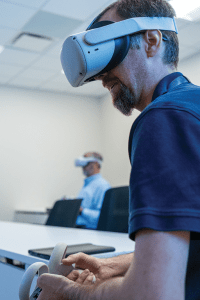
Aviation maintenance is complex yet precise work, requiring extensive training for those who perform it. This is why airlines and MROs alike are looking for new and better ways to train aviation technicians, such as extended reality (XR). Encompassing the three IT-driven technologies known as virtual reality (VR), augmented reality (AR), and mixed reality (MR), XR makes it possible to train technicians faster, more accurately, and without the need for a physical classroom.

Before we examine the detailed benefits of XR for MRO training, let’s begin by defining terms with the help of TJ Moser. He is Varjo’s USAF account executive and a former USAF officer/aviator. Varjo Technologies is a Finnish company that specializes in industrial-grade VR/MR headsets.
“VR is a fully digital environment, where the technician is completely immersed in a virtual hangar or engine room,” said Moser. “This is ideal for procedure familiarization where physical hardware is unavailable. AR uses digital overlays, like text or 2D diagrams. It provides ‘just-in-time’ information but typically lacks deep spatial integration, realistic shadows, and struggles with contrast in bright, outdoor conditions. MR is the most advanced form of XR. It blends the physical and digital worlds, so they seamlessly interact. For example, a technician can see their real hands and physical tools while interacting with a virtual aircraft engine. It combines the immersion of VR with the tactile utility of the real world.”
Why XR is So Useful for MRO Training
Talk to the experts, and you’ll soon learn the many ways in which XR is so useful for training MRO technicians.

Take CAE: “VR, especially when it comes to aircraft technician training, is proving to be a high-value solution, especially when it comes to offering our customers flexibility,” said David Bienvenu, the company’s global leader of maintenance training. “VR offers multiple benefits including a reduced need for physical equipment, minimized downtime for the aircraft, cost-effective repetitive practice, and the VR modules’ adaptability to new aircraft.”

Airbus Helicopters’ training academy is similarly impressed by XR. “We believe that these technologies contribute to improving the trainee experience in order to bridge between classroom theory and hangar floor practice,” said Melchior Kaag, the company’s VP head of training and flight operation services. For instance, XR training helps technicians to develop risk-free muscle memory by practicing high-stakes procedures, such as a complex engine removal, dozens of times without consequences in a virtual environment. “They build the necessary ‘muscle memory’ and procedural confidence without any risk of damaging flight-critical components or expensive tooling,” he said.
Meanwhile, AR training lets trainees “see inside” physical aircraft systems. “We can overlay electrical currents or hydraulic flows onto the aircraft, helping technicians understand the ‘why’ behind a failure, rather than just following a ‘how-to’ checklist,” said Kaag. “We can also simulate critical situations in XR that are impossible to replicate safely in real life, such as localized fires, structural cracks, or specific bird-strike damage. This prepares technicians for rare but high-impact maintenance scenarios in a controlled, safe setting.”

Sanddeep Sinha is head of global strategies at Qvolv Technologies, a developer of XR software for training, safety simulations, and digital twin applications. In addition to the benefits outlined above, he cites AR for effectively supporting ad hoc training on the job site. “In the real-world scenario even, experienced technicians sometimes face unfamiliar equipment, where manuals are thick, and time pressure is high,” Sinha told Aviation Maintenance. “With augmented reality smart glasses, instructions appear directly on the equipment through immersive manuals. One plant manager told us their downtime dropped significantly because technicians no longer spent hours searching manuals.”
XR can also be used to capture the skills of experienced technicians about to retire, so that this knowledge remains in the organization. “Within a VR module, a master welder demonstrates techniques,” said Sinha. “Young learners can observe, practice, and get feedback on accuracy. As well, in a VR/MR environment, we can measure how long a tech takes, where they hesitate, and what errors they make. This allows us to tailor training. If a trainee finds safety procedures difficult, they can practice just that section until they get it right. Training becomes smarter, not longer.”
Finally, XR supports training anywhere, anytime. “Immersive tech can provide top-class training in small towns and Industrial Training Institutes,” he said. “The trainee in a rural training center can learn to maintain turbines used in global industries. This provides equal opportunities for all.”

How These Companies are Using XR in MRO Technician Training
We began this article by having the experts talk about the use of XR in MRO technician training in general. Now we will dig deeper, by asking each of them how they use it.
Airbus Helicopters’ training academy uses XR training on an incremental basis. They start with basic applications and then move into XR more deeply as the trainees become comfortable with it.
“The first steps consist in using a digital mock-up of the helicopters and the simulation of helicopter behavior,” said Kaag. These tools include Virtual Maintenance Trainers, where technicians can move around a realistic virtual helicopter to identify components and practice procedural tasks. The Helionix Advanced Tool Simulator (HATS) also falls into this category. HATS is a desktop or touch-panel training device that replicates the Helionix avionics suite. “Specifically designed for our Helionix-equipped aircraft—like the H135, H145, H175 and H160—technicians use this troubleshooting simulator to make the transition from theory to practical cockpit management,” he said.
CAE is using XR to accelerate a student’s progress to becoming an effective MRO technician. To make this happen, “CAE has integrated advanced VR technology into some of our maintenance technician training programs, which allows us to create detailed digital twins of aircraft,” said Bienvenu. “This VR capability enables technicians to engage with aircraft systems, components, and procedures in a fully immersive, simulated environment. By doing so, they can build their skills and confidence in a safe setting before handling the actual aircraft. This approach is transforming the aviation maintenance industry, fostering greater competency, adaptability, and safety.”
CAE has deployed cloud-based VR simulations to support its latest Gulfstream and Dassault maintenance programs for the G500/600, G650, and Falcon 6X. “Technicians can perform maintenance tasks in this virtual environment in several teaching modes, including an evaluation mode that allows technicians to measure their skills independently,” Bienvenu said. “An instructor-led mode also exists that will guide students through the various steps to perform certain troubleshooting tasks. As we gather feedback from our customers on VR, the intent is to roll out across other aircraft platforms.”
Qvolv Technologies is using VR, AR, and MR for MRO technician training. In the VR realm, “we create virtual twins of machines and perform simulations of maintenance activities,” said Sinha. “They support aviation training sessions where a technician is able to perform simulations of dismantling parts of an aircraft, troubleshooting hydraulic issues, and conducting inspections within a virtual environment before working on an actual plane. This approach provides no risk of damaging equipment, no loss of time due to errors, and the opportunity for unlimited repetitions by the student until they get it right.”
In the MR realm, Qvolv allows senior engineers to guide field technicians remotely. “A field technician at a plant can share his/her view with a senior engineer who is located in another city,” Sinha explained. “The senior engineer can then draw arrows on the view of the field technician to show them what to do. We achieve this through immersive collaboration platforms like Q Connect, which enable teams to interact with digital twins and share live annotations.”

As for Varjo? According to Moser, “We work with industry leaders like Lockheed Martin, Boeing, and FlightSafety International-Defense. While our technology is primarily used for more complex and demanding aviation training use cases, our partner AXIS Flight Simulation has developed a mixed reality training solution using Varjo technology for ‘Virtual Cockpit Procedure and Walkaround Trainers.” Technicians can perform pre-flight inspections and external maintenance checks in a high-fidelity virtual environment. Additionally, through our partner Lockheed Martin’s Prepar3D platform, maintenance crews can rehearse complex system diagnostics. By using the Varjo XR-4 Series headsets, they can read tiny labels and identify hair-thin cracks in virtual components that are invisible in lower-resolution headsets.”
Benefits for Everyone
Ask the experts to detail the benefits of XR for MRO technician training, and chances are you’ll get a list.

Here is one from Varjo’s TJ Moser. “For MROs: Cost savings. A physical engine simulator can cost millions; an XR-based station costs tens of thousands and can be updated instantly via software when a new engine variant is released,” he said. “For clients (Airlines/Military Operators): Faster turnaround times. Better-trained technicians work more efficiently and make fewer errors, leading to higher fleet reliability. Finally, for technicians (MRO employees): Increased confidence. Data shows that XR training can increase student confidence by up to 275% compared to traditional classroom settings. It also provides a more engaging, modern work environment that helps with talent retention, as especially new, younger trainees are already familiar with tech and XR.”

Airbus Helicopters is currently conducting studies to quantify the actual impact of XR on technician training. “Nevertheless, Airbus Helicopters’ feedback is the following,” Kaag said, citing his own list. “For trainees: Increased engagement, motivation, concentration and memorization, plus increased confidence and safety. Technicians can ‘fail’ safely in a digital environment, which reduces the stress and anxiety associated with high-stakes maintenance.
Training to manage unusual situations. Technicians can be immersed in rare scenarios thanks to realistic simulations. Finally, for training centers: On one hand, limited training space for real scale 1:1 physical mock-ups, while on the other hand less costly development and recurring costs for XR-based systems. XR also offers the ability to modify the scenario depending on the trainee evolution, and immediate feedback thanks to virtual trainer voice communications.”

CAE’s list of benefits is less list-like. “Utilizing VR in MRO training and operations provides significant benefits across the board,” said Bienvenu. “Customers love being able to bring an aircraft inside the classroom environment, where VR, in particular, allows for special orientations that make learning objectives — such as identifying component locations or performing removal and installation tasks — much easier to deliver. Students can access parts of the aircraft they would not normally see during routine maintenance, explore onboard maintenance computers, and evaluate faults that may not exist on their own aircraft, providing hands-on experience in a risk-free environment.”
For MROs, using XR technology improves training efficiency and standardization, he noted, reducing the need for on-aircraft instruction while accelerating skill development. “Employees gain confidence and deeper understanding by practicing complex procedures virtually before performing them in the hangar,” Bienvenu told Aviation Maintenance. “For clients, these tools ensure higher-quality maintenance, as technicians are better prepared and familiar with their aircraft systems. OEMs have come to expect this level of advanced training technology and often collaborate to push the development of new VR applications, keeping the entire MRO ecosystem at the cutting edge of safety, efficiency, and operational readiness.”
Over at Qvolv Technologies, Sanddeep Sinha fielded the benefits question by saying, “Let me answer this the way we often explain it to partners — not in numbers first, but in people. One evening, after a long training session, a young technician told us, ‘Sir, today I was not scared to touch the machine.’ That single sentence captures the real benefit of immersive training. When AR, VR, and MR are used thoughtfully, they don’t just improve processes — they change how people feel about their work. And that impact spreads across MRO companies, their clients and the technicians themselves.”
The Limits of XR Training
Even with the many benefits outlined above, there is only so much that XR-based training can do. “Despite the leaps in technology, for certain elements XR is a supplement, not a replacement,” said Moser. “For instance, it is not a substitute for tactile feedback (haptics). While we can simulate visuals and some sound, the specific ‘feel, of a rusted bolt breaking loose or the resistance of a hydraulic line is difficult to replicate perfectly without high-end, expensive haptic rigs. Similarly, the smell of jet fuel or the physical exhaustion of working in a cramped crawlspace with high and low temperature extremes are real-world variables that still require hands-on experience. Finally, leadership, team communication during a ‘hangar floor’ crisis, and the ethical responsibility of signing off on a repair are nuances best taught by human mentors.”
Sinha replied to this question with another list: “What Must Still Be Taught by Humans.” This includes:
• How to handle tools and be precise.
• How to be safe and have a safety culture and discipline.
• How to troubleshoot and have intuition.
• How to be responsible and have a sense of ethics.
• How to have pride in one’s work.
He closed the list by saying, “A wise technician’s advice, ‘Listen to the machine, it will tell you what’s wrong’, is something that software cannot teach.”
David Bienvenu agrees with this caveat. “At CAE, we believe that people learn from people,” he said. “AR, VR, and MR are tools which supplement learning, create opportunities for self-practice and can help ramp up basic skills. But they will never fully replace a person-to-person interaction. People can better gauge the nonverbal cues of students to new materials, adjust the pace of training, or deep dive on a particular subject to help with the student’s specific situation. This is why CAE instructors are the most important element of our training operation. Rarely are AR and VR quoted as elements that have significantly improved a student’s understanding of the aircraft, yet CAE instructors are consistently lauded in our customer experience surveys. In summary, a course with AR/VR/MR capabilities creates new learning opportunities, which the full value is only realized with an experienced, qualified and dedicated instructor.”
What’s Coming Next
Today’s XR-based training is impressive in its own right. But what’s on the horizon may well be mind-blowing. Here are some predictions, some on the verge of coming true.
“We are seeing the integration of AI-driven instructors within the XR environment that can provide real-time feedback,” said Moser. “And while it may never completely eliminate the need to touch a real airplane before a technician is certified, there are expectations that 90% of a technician’s curriculum will eventually move to XR.”
“Future systems will use artificial intelligence to track a student’s gaze and hand movements in VR, instantly identifying where they are hesitant and adjusting the lesson in real time.” Kaag said. Meanwhile, AI-powered training modules “will be able to adapt to the individual technician’s errors and learning pace,” said Sinha. In fact, AI is already being used to create adaptive training and digital twins to help technicians train faster and reduce errors.
In terms of coming advances, “the future convergence of AI and VR represents a transformative synergy which will revolutionize how we build immersive training and skills-development solutions within the aviation industry,” said Bienvenu. “As these technologies continue to evolve in tandem, the convergence of AI and VR is poised to redefine the boundaries of human interaction and pave the way for new and innovative applications across diverse domains within the aviation industry.”
Despite their far-ranging predictions, none of the experts expect humans to be eliminated from the MRO technician training loop.
“I do not believe that VR, AR or MR will take over human instruction,” Bienvenu said. “I — and my colleagues at CAE —believe these are tools to help, but the human experience and expertise are absolutely fundamental in teaching. Although younger generations enjoy learning via technology, the human element will always be fundamental to an adequate, complete, and safe teaching experience — meaning the human element will always be paramount to an adequate, complete and safe aircraft.”
“At Qvolv, we believe that the future of MRO training is not technology versus the human,” concluded Sinha. “Rather, the future of MRO training is technology and the human.”